Skip to content

Best Telecom Website Examples (And Why They Convert)

We scored 9 telecom homepages on 60+ conversion criteria. See which sections separate the top performers, and what your page is probably missing.

Updated June 20269 pages analyzed
#CompanyScore

Scored by AI across 60+ conversion criteria

Neat landing page
#1
76/100
Scroll to explore
Analyze your telecom pageFree. Takes 2 minutes.

What the best telecom websites get right

Telecom buyers arrive with split intent. Developers want docs and quick starts, enterprise buyers want compliance proof and uptime guarantees. The strongest telecom website design patterns in this benchmark do four things consistently:

53.1/100

Avg. page score

  • Route audiences immediately. Use navigation and hero CTAs to separate developer self-serve paths from enterprise sales paths so neither audience has to parse messaging built for the other.
  • Prove reliability before the feature tour. Show uptime SLAs, compliance badges, and conversation volume so buyers trust your infrastructure before they evaluate your API.
  • Neutralize the integration objection. Surface SDKs, code samples, or "no coding required" messaging so the next step feels achievable in minutes, not months.
  • Segment by use case. Design for teams buying voice, messaging, video, or AI (each with different evaluation criteria), instead of forcing one generic narrative.

6 best telecom homepages analyzed in detail

Each company below is paired with its strongest section and scored across 60+ conversion criteria. See what they get right, and what you can borrow for your own telecom homepage design.

01

Neat

Editor's pick76/100

What makes this page stand out

  • The hero stacks “4,200+ 5-star reviews,” three trust badges, “Cancel anytime,” and “30-day money-back guarantee” under CTAs.
  • The primary CTA “Try Neat For Free” appears in the header and hero, paired with “See How It Works!”.
  • The “HOW NEAT WORKS” section uses three benefit headlines and green-check bullet lists like “Automatic expense categorization”.
  • The testimonials carousel shows headshots, names, job titles, and five-star icons alongside quoted reviews.

Section we love

·Cta
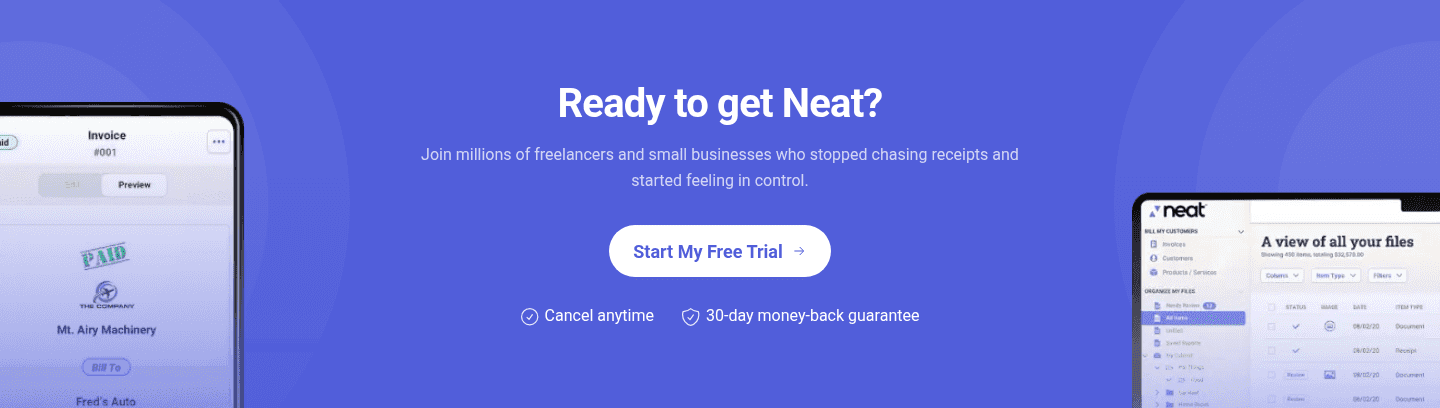
Neat Cta section
  1. 1One dominant button (Start My Free Trial) with no competing actions keeps the click decision simple
  2. 2Reassuring microcopy (Cancel anytime, 30-day money-back guarantee) sits right under the button to kill last-minute doubt
  3. 3Real product UI flanks the CTA (invoice mockup on the left, file dashboard on the right) so users see what they get
  4. 4Subhead names the audience (freelancers and small businesses) and the relief (stopped chasing receipts) to make the trial feel relevant
02

Dyte, Video and voice SDKs with developer-first navigation and industry-specific use cases.

64/100
Gabriel AmzallagGabriel AmzallagFounder, Web Anatomy

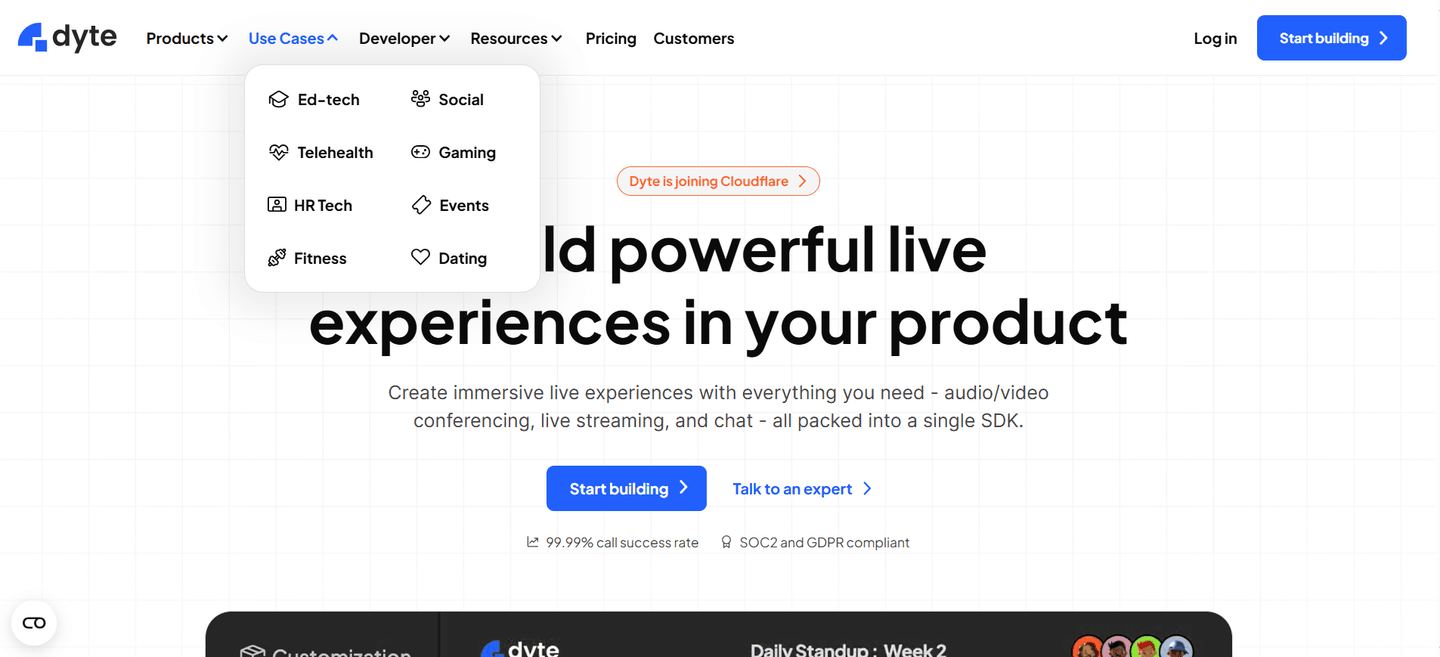
Dyte's homepage bridges the developer-enterprise gap with a navbar that scores 100 (top-scoring). A Use Cases dropdown with industry icons and a dedicated Developer tab let technical buyers self-select instantly, while the "Start building" CTA matches the developer audience without alienating business evaluators.

What makes this page stand out

  • Plugin-based architecture enables highly customizable video experiences
  • Low-latency, high-quality streaming for up to 10,000 participants demonstrates enterprise scale
  • Pre-built UI components accelerate developer integration timelines
  • Cross-platform support (Web, iOS, Android, Flutter, React Native) ensures universal reach

Section we love

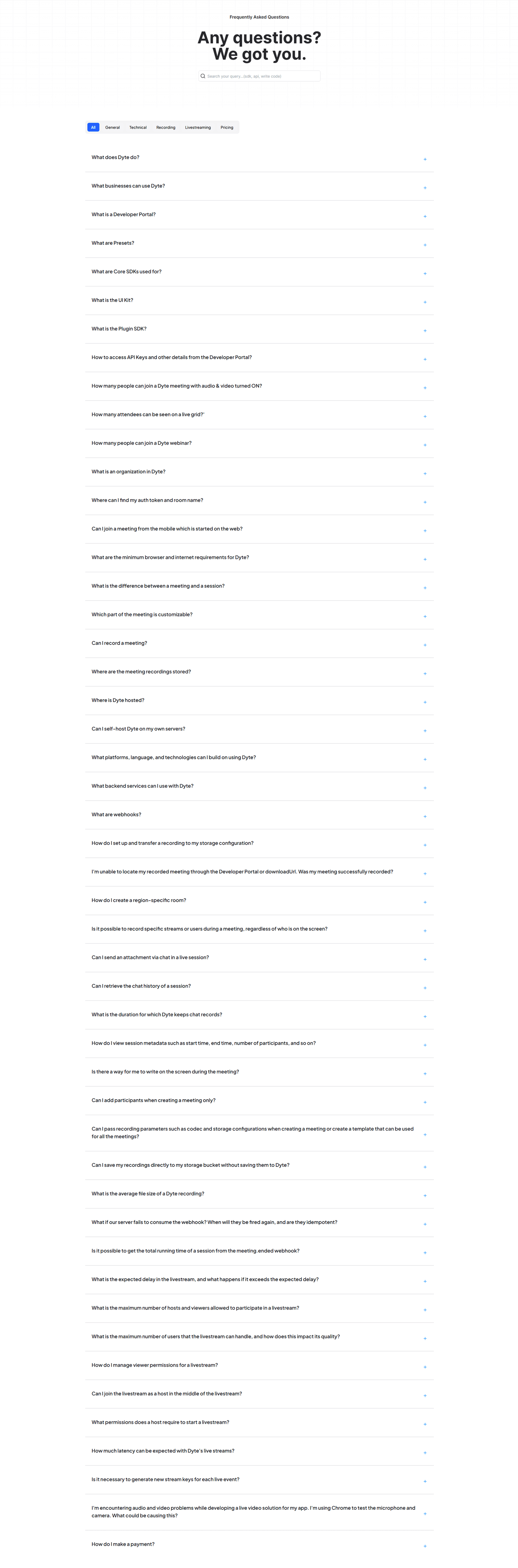
·FaqBest in class
Dyte Faq section
  1. 1Search bar plus topic tabs (General, Technical, Recording, Livestreaming, Pricing) make a huge list findable
  2. 2Self-host, hosting location, and storage bucket questions tackle the security and data-control objections
  3. 3Browser and internet requirement questions answer setup worries before a developer commits
  4. 4Accordion with expand arrows keeps 40-plus questions usable and supports FAQ schema for search
03

Sinch, Enterprise messaging platform where trust badges and deep navigation replace the hard sell.

54/100
Gabriel AmzallagGabriel AmzallagFounder, Web Anatomy

Sinch leads with partner credibility. The footer (scored 80) packs Meta Business Partner, Trust in Enterprise Messaging, and Score2 IAS badges alongside a "Talk to an expert" CTA and 30+ deep links organized under Products, Resources, and Company, giving enterprise buyers every signal they need to feel safe continuing.

What makes this page stand out

  • API-first approach enables developers to embed communication into any application
  • Global reach with local numbers and carrier connections in 200+ countries
  • Enterprise-grade reliability with carrier-level infrastructure provides trust for mission-critical communications
  • AI-powered features (conversational AI, sentiment analysis) modernize the traditional CPaaS offering

Section we love

·Navbar
Sinch Navbar section
  1. 1The open Solutions menu splits cleanly into Use Cases, Teams and Industries columns with icon headers
  2. 2Use Cases lists concrete jobs (Marketing Campaigns, Identity and Verification, Customer Service)
  3. 3Teams targets roles (Marketing, Security and Risk, Customer Support, Operations)
  4. 4A featured card with integration logos pitches Integrate your software with voice, messaging, email and a Read more link
  5. 5Try for free and Talk to an expert pair a self-serve and sales CTA, with Log in for returning users
04

Aircall, Cloud phone system that segments by team, size, and industry so every buyer finds their fit.

49/100
Gabriel AmzallagGabriel AmzallagFounder, Web Anatomy

Aircall's use cases section scores 100 (top-scoring) by segmenting along three axes: team, business size, and industry. Top Uses like Call Center and AI Voice Agent are surfaced in a clean dropdown, and a "Discover more industries" link keeps vertical buyers exploring instead of bouncing.

What makes this page stand out

  • "More than a business phone — it's an integrated customer communications and intelligence platform" sub-headline elevates the product category
  • Product UI showing inbox with CRM Insight Cards demonstrates the integration value proposition visually
  • AI Agents, data-driven insights, and automation triple value prop addresses modern customer experience needs
  • "Get free access" CTA lowers the barrier vs. typical enterprise phone system sales cycles

Section we love

·Integrations
Aircall Integrations section
  1. 1Count line (100+ other integrations) signals a deep voice ecosystem beyond the featured apps
  2. 2Top logos (Salesforce, HubSpot, Zendesk, Intercom, Shopify, Microsoft Teams) cover the core SaaS stack
  3. 3Category labels (CRM, Help Desk, eCommerce) help buyers spot the integration that fits their use case
  4. 4See all integrations button gives a clear path to confirm a specific tool before committing
05

Zoom, Unified communications platform that frames AI as free and shows the product, not a promise.

47/100
Gabriel AmzallagGabriel AmzallagFounder, Web Anatomy

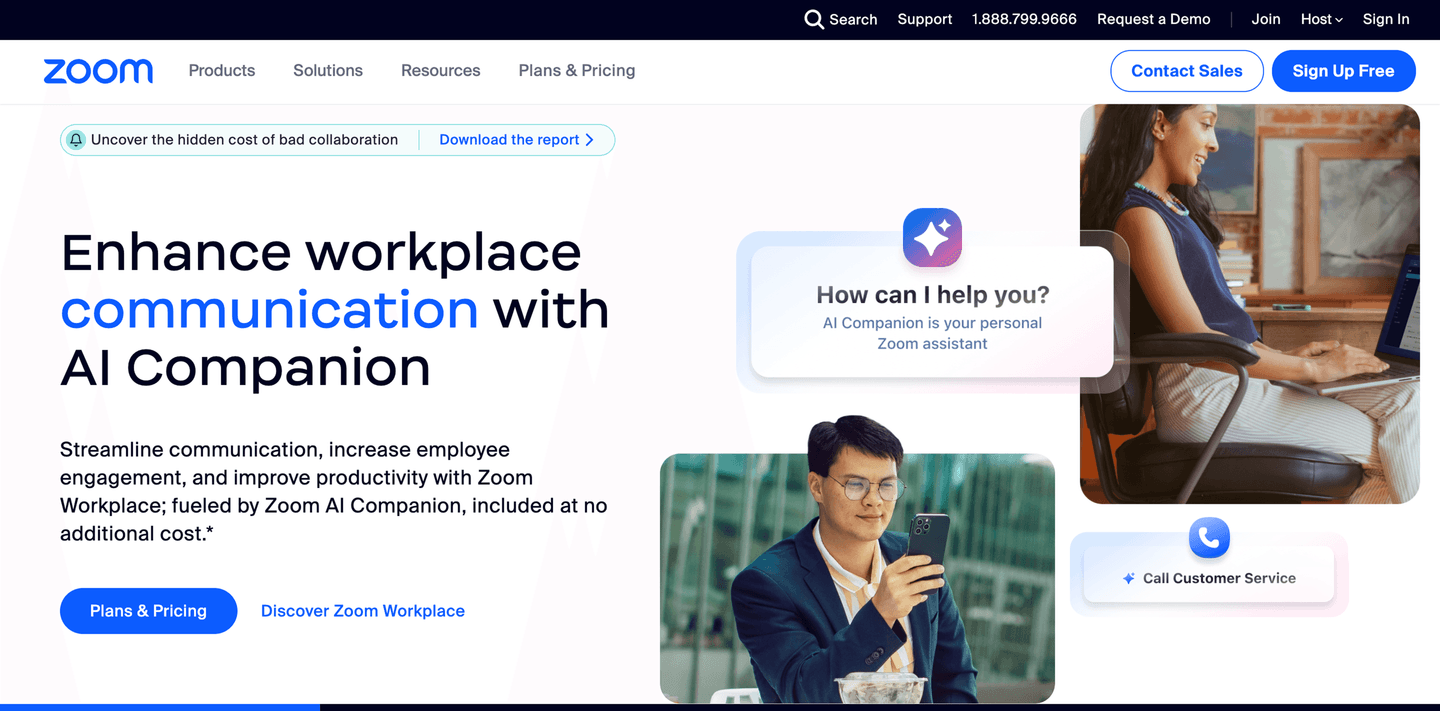
Zoom's hero (scored 56) leads with "Included at no additional cost" to position AI Companion as a free value-add. A real AI Companion UI screenshot and dual CTAs (Plans and Pricing plus Discover Zoom Workplace) route both price-sensitive and exploratory visitors without friction.

What makes this page stand out

  • The product breadth is now significant: meetings, chat, docs, rooms, virtual agent, contact center — demonstrating Zoom's platform ambitions far beyond its pandemic-era identity
  • AI positioning is strong with "Zoom AI Companion 3.0" and the "available at no extra cost" value play — undercutting competitors who charge extra for AI features
  • Analyst validation is powerful: Leader in Gartner Magic Quadrant for UCaaS for 6 consecutive years, plus Forrester Wave leader — creating a wall of third-party credibility
  • Enterprise social proof from Major League Baseball and Capital One adds cross-industry credibility beyond the tech sector

Section we love

·Hero
Zoom Hero section
  1. 1Included at no additional cost positions AI Companion as a free add-on, reducing perceived risk
  2. 2AI Companion UI (How can I help you? and Call Customer Service) shows the real product interface
  3. 3Dual CTAs (Plans and Pricing + Discover Zoom Workplace) serve both purchase-ready and exploratory visitors
  4. 4Streamline communication, increase engagement, and improve productivity promises three clear outcomes
06

Plivo, Communications API where compliance badges and uptime stats replace vague trust language.

44/100
Gabriel AmzallagGabriel AmzallagFounder, Web Anatomy

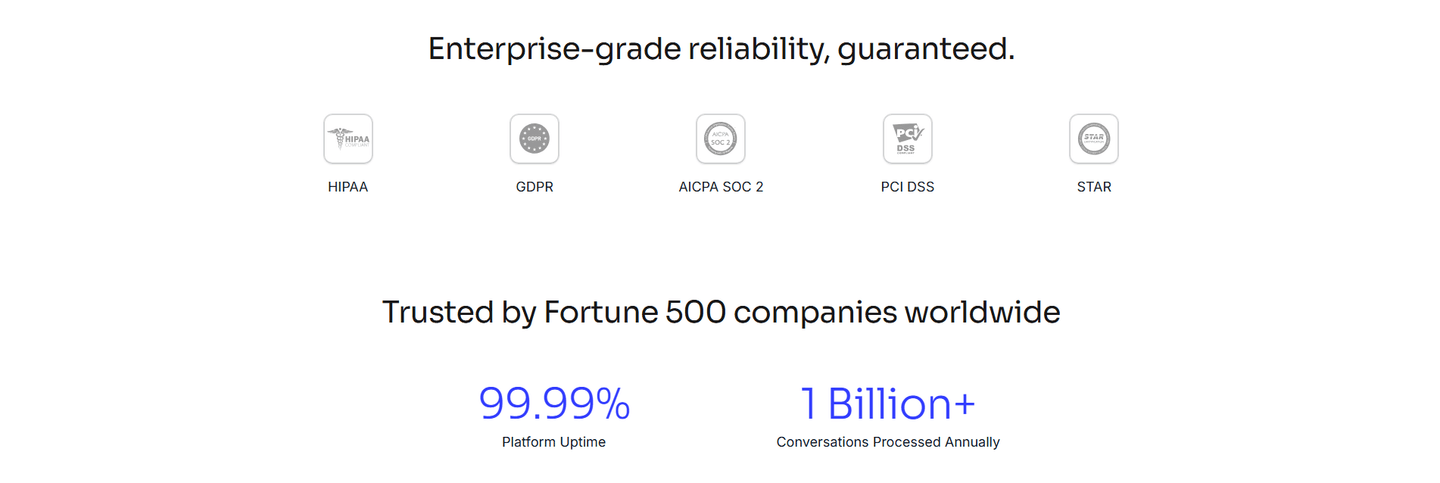
Plivo turns compliance into a competitive advantage. The trust section scores 100 (top-scoring) by stacking five badges (HIPAA, GDPR, SOC 2, PCI DSS, STAR) alongside 99.99% uptime and 1 Billion+ conversations processed annually, proof that scales credibility beyond any single testimonial.

What makes this page stand out

  • Competitive pricing vs. Twilio creates a clear cost-based differentiator for high-volume senders
  • Global coverage with local phone numbers in 100+ countries enables international reach
  • Contact center platform (Contacto) extends from raw APIs into enterprise-ready solutions
  • SIP trunking capabilities address enterprise telephony migration needs

Section we love

·How It WorksBest in class
Plivo How It Works section
  1. 1Three numbered steps (Describe use case, Let Vibe build the flow, Review and launch) make the build path obvious
  2. 2Each step carries a real product screenshot of the builder, flow canvas, and analysis mode so you see the tooling
  3. 3The headline (Go live with AI agents in minutes) sets a concrete fast timeframe for getting to production
  4. 4Copy stresses no code or complexity and a single click to deploy, lowering the perceived effort of building an agent
  5. 5Step 3 previews the end state of a tested agent deployed across channels
  6. 6Two CTAs (Contact Sales and Get Started Now) sit directly under the steps to capture intent

See how your page compares to the 53.1 telecom average

Run a section-by-section diagnostic on your telecom page and get prioritized fixes, then see how you stack up against these telecom website examples.

Design patterns across these telecom pages

Across 9 telecom homepage examples, the strongest telecom web design solves a split-audience problem: developers want quick starts and SDKs, enterprise buyers want compliance proof and uptime SLAs.

The clearest telecom website examples treat reliability as a product feature, using compliance badges, quantified volume, and uptime guarantees so visitors do not have to infer trustworthiness from branding alone. Explore our best landing page examples to compare how other industries resolve similar trust friction.

Trust Plivo

80/100

How Plivo builds credibility early

Plivo trust section
  1. 1The compliance row stacks five recognized seals (HIPAA, GDPR, AICPA SOC 2, PCI DSS, STAR) for enterprise reassurance
  2. 2The 99.99% Platform Uptime figure quantifies reliability against the guaranteed claim
  3. 31 Billion+ Conversations Processed Annually proves real operating scale
  4. 4The mix of certification badges plus hard metrics combines two distinct proof types
  5. 5Trusted by Fortune 500 companies worldwide adds a recognizable buyer tier

Reviewed design-pattern pick from Plivo’s trust section.

What I love about this section

  • The compliance row stacks five recognized seals (HIPAA, GDPR, AICPA SOC 2, PCI DSS, STAR) for enterprise reassurance
  • The 99.99% Platform Uptime figure quantifies reliability against the guaranteed claim
  • 1 Billion+ Conversations Processed Annually proves real operating scale
  • The mix of certification badges plus hard metrics combines two distinct proof types

Value Proposition ElevenLabs

67/100

How ElevenLabs presents their value

ElevenLabs value proposition section
  1. 1Unique mechanism stated plainly: own foundational models built from the first human-like voice model outward
  2. 2Multiple propositions span transcription, music, voice cloning and intelligent agents, not one repeated claim
  3. 3Interactive release timeline (Scribe v2, Jan 2026) turns research progress into a tangible visual story
  4. 4Learn more link plus dated cards (Introducing Scribe v2, Eleven Music is Here) give a clear path to depth

Reviewed design-pattern pick from ElevenLabs’s value proposition section.

What I love about this section

  • Unique mechanism stated plainly: own foundational models built from the first human-like voice model outward
  • Multiple propositions span transcription, music, voice cloning and intelligent agents, not one repeated claim
  • Interactive release timeline (Scribe v2, Jan 2026) turns research progress into a tangible visual story
  • Learn more link plus dated cards (Introducing Scribe v2, Eleven Music is Here) give a clear path to depth

Features ElevenLabs

67/100

How ElevenLabs showcases their product

ElevenLabs features section
  1. 1Two real product panels show the actual output: an all-in-one audio editor and a localized speech demo with a language picker
  2. 2A Play button on the dubbing panel lets visitors hear the feature in action instead of just reading about it
  3. 3Four supporting cards (Music, SFX, Voices, Image and Video) surface secondary capabilities without crowding the two hero features
  4. 4Card copy leads with the outcome (Generate studio-quality tracks instantly, Create a replica of your own voice) not the tech

Reviewed design-pattern pick from ElevenLabs’s features section.

What I love about this section

  • Two real product panels show the actual output: an all-in-one audio editor and a localized speech demo with a language picker
  • A Play button on the dubbing panel lets visitors hear the feature in action instead of just reading about it
  • Four supporting cards (Music, SFX, Voices, Image and Video) surface secondary capabilities without crowding the two hero features
  • Card copy leads with the outcome (Generate studio-quality tracks instantly, Create a replica of your own voice) not the tech

Sections telecom teams underuse (but visitors still look for)

Even with a strong hero, secondary sections often decide whether someone keeps reading, especially in telecom where both technical and business buyers need distinct reassurance at each scroll depth.

In this dataset, Hero tends to outperform at 61.3 while Trust is the most fragile at 40, suggesting many telecom pages invest in messaging but leave gaps in navigation, integrations, and process clarity that slow decisions. See how best fintech websites handle similar trust gaps in adjacent technical infrastructure.

Footer Sinch

80/100

How Sinch closes the page with confidence

Sinch footer section
  1. 1Links grouped into labeled columns (Products, Resources, Company) with regional phone numbers for each market
  2. 2Talk to an expert button placed high in the footer drives secondary conversion for undecided visitors
  3. 3Trusted and certified row shows Meta Business Partner and Trust in Enterprise Messaging badges for credibility
  4. 4Legal, Privacy, and Report Scams links sit in the bottom bar for clear compliance and transparency

Reviewed overlooked-section pick from Sinch’s footer section.

What I love about this section

  • Links grouped into labeled columns (Products, Resources, Company) with regional phone numbers for each market
  • Talk to an expert button placed high in the footer drives secondary conversion for undecided visitors
  • Trusted and certified row shows Meta Business Partner and Trust in Enterprise Messaging badges for credibility
  • Legal, Privacy, and Report Scams links sit in the bottom bar for clear compliance and transparency

Navbar Dyte

71/100

Why this navbar works

Dyte navbar section
  1. 1The open Use Cases menu sorts buyers into eight verticals (Ed-tech, Telehealth, HR Tech, Fitness, Social, Gaming, Events, Dating)
  2. 2The Pricing tab sits inline with Products and Customers, keeping cost one click away
  3. 3The blue Start building CTA anchors the top-right corner for a clear next step
  4. 4The Log in link offers returning users a quick utility path
  5. 5The nav layers Products, Developer and Resources for both buyers and builders

Reviewed overlooked-section pick from Dyte’s navbar section.

What I love about this section

  • The open Use Cases menu sorts buyers into eight verticals (Ed-tech, Telehealth, HR Tech, Fitness, Social, Gaming, Events, Dating)
  • The Pricing tab sits inline with Products and Customers, keeping cost one click away
  • The blue Start building CTA anchors the top-right corner for a clear next step
  • The Log in link offers returning users a quick utility path

Pricing Aircall

60/100

How Aircall creates pricing transparency

Aircall pricing section
  1. 1Deep matrix with checkmarks and values across 3 plans (Essentials, Professional, Custom) supports a thorough side by side read
  2. 2Blue category banners (Initial setup, Collaboration, Analytics, Productivity, AI & transcription, Apps & Integrations, Admin & Security) split 80+ rows
  3. 3Professional column wrapped in a green-tinted box runs the full table length to steer buyers toward the middle tier
  4. 4Top rows surface concrete limits (user counts, call recording retention, AI Assist labels) so plan tradeoffs are clear before scrolling

Reviewed overlooked-section pick from Aircall’s pricing section.

What I love about this section

  • Deep matrix with checkmarks and values across 3 plans (Essentials, Professional, Custom) supports a thorough side by side read
  • Blue category banners (Initial setup, Collaboration, Analytics, Productivity, AI & transcription, Apps & Integrations, Admin & Security) split 80+ rows
  • Professional column wrapped in a green-tinted box runs the full table length to steer buyers toward the middle tier
  • Top rows surface concrete limits (user counts, call recording retention, AI Assist labels) so plan tradeoffs are clear before scrolling

If you are refreshing a telecom landing page design, treat these "unsexy" blocks as conversion infrastructure, not filler.

How does your telecom homepage compare?

Five quick questions to see where your page stands against this telecom benchmark. For a full section-by-section audit, try our landing page analysis.

Interactive quiz

What would your telecom homepage score?

Question 1 of 5
0%

Can a developer and an enterprise buyer each find their path in under 5 seconds?

Separate nav tabs, dual CTAs ("Start building" vs "Talk to sales"), or use-case dropdowns that segment by role.

Gabriel Amzallag

Reviewed by

Gabriel Amzallag , Founder, Web Anatomy

5 years CRO + SEO at Qonto (2021–2025). After advising 15+ SaaS on their websites (Payfit, Pigment…), the same patterns kept breaking, so I decided to build the source of truth on what works on the web: the intelligence layer every tool, builder, and team uses to ship sites that perform.

See how your page compares to the 53.1 telecom average

Run a section-by-section diagnostic on your telecom page and get prioritized fixes, then see how you stack up against these telecom website examples.

Analyze your telecom pageFree. Takes 2 minutes.

Explore other industries

See how conversion patterns differ across verticals. Each page scores real homepages on the same framework.

See all industries
Benchmark-backed answers for telecom website design

FAQ: Best Telecom Websites (Telecom Benchmarks)

Quick answers to common questions about what makes the best telecom websites convert, based on section-level benchmark data from this telecom review.

What makes telecom websites harder to convert than other industries?

[01]

Telecom websites serve split audiences. Developers evaluate APIs while enterprise buyers compare vendors, so the page must route both without creating friction for either. Across 9 homepages reviewed in this June 2026 benchmark, Dyte, Sinch, Aircall, and Plivo treat routing as structure, not decoration. Dyte gives developers a dedicated nav tab. Aircall segments use cases across team, size, and industry. Plivo stacks HIPAA, GDPR, SOC 2, PCI DSS, and STAR badges so neither audience has to hunt for proof.

Should a telecom homepage lead with features or trust?

[02]

Reliability proof and audience routing first, features second. Across 9 telecom pages reviewed, Plivo opens with a 99.99% uptime claim and 1 Billion+ conversations processed annually before any feature tour, Sinch leads with Meta Business Partner and Trust in Enterprise Messaging badges, and Dyte's "Start building" CTA matches developer intent without alienating business evaluators. Feature lists land harder when infrastructure trust is already established.

What is the biggest messaging mistake on telecom homepages?

[03]

Treating developers and enterprise buyers as one audience. The average page in this June 2026 benchmark scored 53.1 across 9 pages. Top performers give each audience its own path: Dyte's Use Cases dropdown uses industry icons (Ed-tech, Telehealth) while a separate Developer tab keeps docs one click away, and Zoom pairs "Included at no additional cost" AI Companion framing with dual CTAs (Plans and Pricing plus Discover Zoom Workplace) for both price-first and exploratory visitors.

How do you find the best telecom websites to review before a redesign?

[04]

Compare real pages side by side, section by section, not as full-page screenshots. This review scores 9 telecom homepages against 60+ criteria. The strongest performers are Dyte (developer routing), Sinch (enterprise trust badges), Aircall (use-case segmentation), Plivo (compliance-as-proof with HIPAA, GDPR, SOC 2, PCI DSS, and STAR badges), and ElevenLabs (interactive product timeline).

How should a telecom team sequence a homepage redesign across marketing, product, and compliance?

[05]

Start with compliance and product reviewing the hero claims together. Telecom teams lose weeks when marketing ships a claim like Plivo's "99.99% uptime" or "1 Billion+ conversations" that legal quietly strips later, so lock the numbers first. Then map two audience paths. Dyte shows the template: developers need a docs link within one scroll, enterprise buyers need a compliance and SLA section, and the hero should route both without forcing either off-page. Visual design is the final sprint. It's the least controversial piece.

What is the best website for telecom?

[06]

There is no single best. It depends on your product line. For developer-first CPaaS, Dyte is the template (dedicated dev nav tab, industry-specific use cases). For enterprise messaging, Sinch leads with partner-credibility badges. For voice, Aircall segments by team and industry. For regulated communications, Plivo stacks HIPAA, SOC 2, and GDPR next to 99.99% uptime. For AI voice, ElevenLabs shows its research depth with an interactive product timeline. All 9 telecom homepages in this June 2026 review are scored on the same rubric.

Where can I find great telecom website design inspiration?

[07]

Study telecom website examples section by section instead of saving full-page screenshots. Browse best landing page examples for the full gallery, then drill into hero section examples, trust section examples, and pricing section examples to see how Dyte, Sinch, and Plivo differ at each funnel stage.