Best Cybersecurity Website Examples (And Why They Convert)
We scored 18 cybersecurity homepages on 60+ conversion criteria. See which sections separate the top performers, and what your page is probably missing.
5 years CRO + SEO at Qonto (2021–2025). After advising 15+ SaaS on their websites (Payfit, Pigment…), the same patterns kept breaking, so I decided to build the source of truth on what works on the web: the intelligence layer every tool, builder, and team uses to ship sites that perform.
“Veridas structures a complex identity verification platform into a navigable experience. The mega menu splits Industries (6 verticals) and Use Cases (3 solutions) with a featured case study (Maxxa + Veridas) including an image, so visitors self-qualify before scrolling. Use Cases map by function (KYC, Auth, Age Verification), creating clarity for buyers with different security mandates.”
What makes this page stand out
Gartner Visionary recognition badge provides immediate third-party authority in the identity verification space
Banking client logos (BBVA, Scotiabank, CaixaBank, Macropay) signal enterprise-grade trust for financial services buyers
"100% proprietary suite of solutions" emphasizes technology ownership — key differentiator vs. resellers or aggregators
Mobile device UI mockup showing face verification provides instant visual understanding of the product
Section we love
·ResourcesBest in class
1Featured Identity Fraud Report 2025 with the stat 1.4% of verifications show injection activity positions Veridas as a data source
2Download report now CTA on the hero report implies an email gate that captures high intent leads
3Clear hierarchy puts the flagship report banner on top and the expert articles in a smaller grid below
4Article topics (medical identity fraud, MFA breaches, iGaming fraud) map directly to the identity and biometrics product
5Learn More links per card plus a More resources link drive visitors deeper into the resource library
02
Wiz
63/100
What makes this page stand out
The primary CTA “Get a demo” repeats in the header and hero, reinforcing one action throughout the page.
The above-the-fold form collects Work Email, First/Last Name, Country, Phone, and Company before “Submit.”
The trust band claims “Trusted by more than 50% of Fortune 100 companies” alongside logos like Salesforce, BMW, and Morgan Stanley.
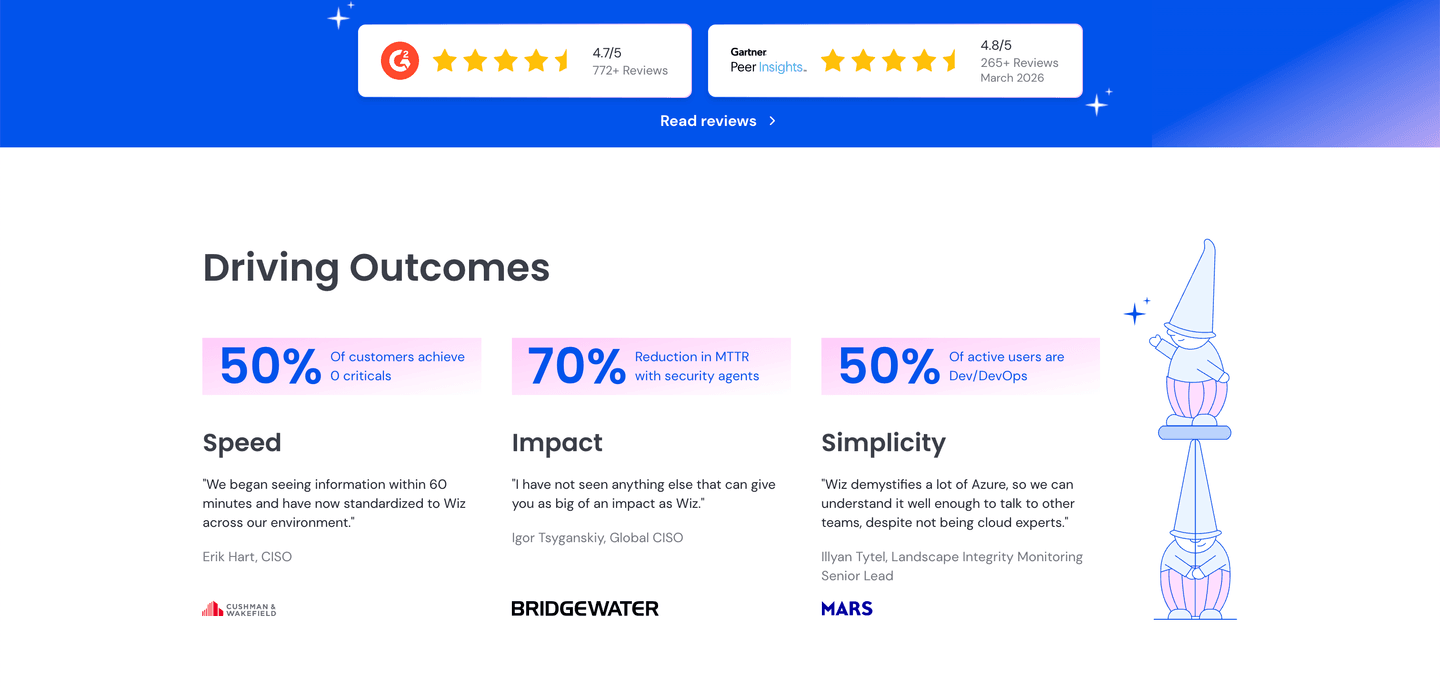
The reviews section states “Customers rate Wiz #1 in cloud security” and shows “772 Reviews” with multiple G2 Winter 2025 badges.
Section we love
·TrustBest in class
1Third-party scores lead with G2 at 4.7/5 (772+ reviews) and Gartner Peer Insights at 4.8/5 (265+ reviews)
5 years CRO + SEO at Qonto (2021–2025). After advising 15+ SaaS on their websites (Payfit, Pigment…), the same patterns kept breaking, so I decided to build the source of truth on what works on the web: the intelligence layer every tool, builder, and team uses to ship sites that perform.
“Anvilogic turns SIEM fatigue into a measurable improvement story. Quantified headlines (cut 45% alert noise, 98% confidence, 50%+ MTTD reduction) pair with pain-to-outcome mapping that connects SIEM costs to a savings calculator. Real product dashboards replace generic screenshots, giving security teams something concrete to evaluate.”
What makes this page stand out
The "Multi-SIEM Detection Platform" category creation is strategically brilliant: it reframes the conversation from "replace your SIEM" to "layer detection across all your SIEMs" — a much easier sell
Clear capability differentiation around threat detection engineering, automated triage, and cross-SIEM correlation addresses the security operations center's (SOC) most time-consuming workflows
The specific problem framing — security teams drowning in alerts with insufficient context — resonates viscerally with every SOC analyst and CISO who's lived through alert fatigue
Platform-agnostic positioning (works across Splunk, Sentinel, Chronicle, etc.) transforms Anvilogic from a point solution into essential infrastructure for multi-cloud security operations
Section we love
·Cta
1Single dominant CTA (Augment your SIEM) uses a direct verb tied to the user existing stack
2Real product widget (Mean Time to Detect 5min with slider, Splunk card) shows a concrete result near the CTA
3See also links (Splunk, Sentinel, Hybrid) give hesitant buyers secondary paths without competing with the main button
04
Semgrep
60/100
What makes this page stand out
The hero headline reads “Code Security for Builders,” paired with copy promising unified SAST, SCA, and secrets scanning.
The primary CTAs repeat “Book a demo” and “Try for free,” including a top-nav “Try for free.”
Customer logos from Lyft, Dropbox, Figma, Slack, GitLab, HashiCorp, Trail of Bits, and Vanta sit under “Loved by…”.
The benefits section uses quantified claims—“80% fewer false positives,” “95% of security reviewers,” “6M+ findings,” and “up to 98%.”
Section we love
·Integrations
1Logo constellation surfaces developer-trusted tools (GitHub, GitLab, VS Code, Bitbucket, Jira) around the Semgrep mark
2Workflow lines like PR checks in GitHub and Jira ticketing routing make the integrations concrete, not just names
3Forward-looking MCP integrations for AI tools like Cursor and Replit signal the product fits modern dev stacks
4Learn More link gives prospects a path to verify their exact stack before committing
05
Faraday, Predictive security with dual CTAs and audience-specific framing.
5 years CRO + SEO at Qonto (2021–2025). After advising 15+ SaaS on their websites (Payfit, Pigment…), the same patterns kept breaking, so I decided to build the source of truth on what works on the web: the intelligence layer every tool, builder, and team uses to ship sites that perform.
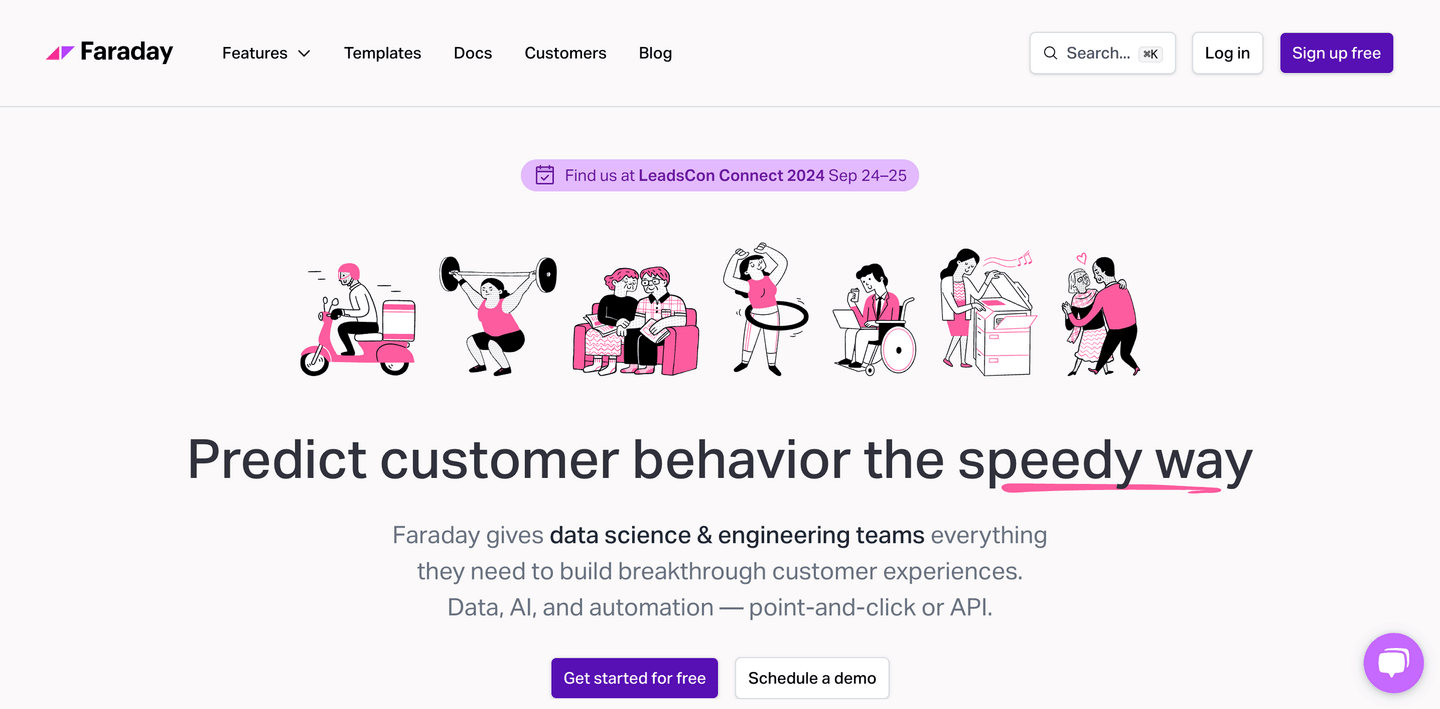
“Faraday keeps the page lightweight while serving two distinct buyer paths. Dual CTAs (Get started free + Schedule demo) sit next to audience-specific language for data science and engineering teams. The headline ("Predict customer behavior the speedy way"), stays concrete and avoids the jargon trap most security pages fall into.”
What makes this page stand out
Clear ICP targeting: "Faraday gives data science & engineering teams everything they need to build breakthrough customer experiences" — specific audience, specific outcome.
"Data, AI, and automation — point-and-click or API" communicates flexibility for both technical and non-technical users.
Dual CTAs "Get started for free" and "Schedule a demo" accommodate self-serve and sales-assisted paths.
Whimsical, diverse character illustrations create a friendly, approachable brand feel that contrasts with the typically sterile data science aesthetic.
Section we love
·Hero
1Dual CTAs (Get started for free and Schedule a demo) with free option reduce commitment anxiety
2Audience specificity (data science and engineering teams) tells technical buyers this tool is for them
3Headline (Predict customer behavior the speedy way) combines product category with a speed benefit
4Subtext mentions both point-and-click and API delivery methods covering technical and non-technical users
06
Stytch, Auth infrastructure positioned as the definitive Auth0 alternative.
5 years CRO + SEO at Qonto (2021–2025). After advising 15+ SaaS on their websites (Payfit, Pigment…), the same patterns kept breaking, so I decided to build the source of truth on what works on the web: the intelligence layer every tool, builder, and team uses to ship sites that perform.
“Stytch owns the comparison frame. A clean feature matrix pits Stytch against Auth0 across 7 features, with Stytch winning all 7 rows. The "most powerful alternative to Auth0" tagline sets the evaluation context before the visitor builds their own shortlist, which is especially effective for auth-security buyers already comparison-shopping.”
What makes this page stand out
Customer logos (Zapier, Calendly, Groq, HubSpot, Cisco, Replit) demonstrate traction across major tech companies.
Dual CTAs ("Get started" + "Book a demo") serve both self-serve developers and enterprise security teams.
The "& AI agents" addition to the identity platform positioning is a timely differentiator as AI agents proliferate across enterprise software.
The dual-persona approach (human + AI identity) expands the total addressable market while maintaining product coherence.
Section we love
·Contact
13-field sales form (First name, Last name, Work email) keeps the talk-to-sales path very low friction
2Alternative channels on the left (Join our Slack, Email us, Search our forum) give self-serve options
3Split layout separates product support from sales so visitors pick the right path fast
See how your page compares to the 51.7 average page score
Run a diagnostic on your cybersecurity page and get a section-by-section breakdown of what to fix first to improve clarity, proof, and product evidence.
Design patterns we see across high-performing cybersecurity pages
Across 18 cybersecurity pages reviewed, the pages that convert tend to make the first screen do one job: quantify the problem and show proof that the product solves it.
The strongest patterns pair specific, outcome-led claims with real product evidence (dashboards, architectural diagrams, detection timelines), then back those claims with metrics that map to how security teams actually evaluate vendors. With Value Proposition, Cta, and Trust as the highest-performing section types and Value Proposition leading at 52, the best cybersecurity website design treats proof as the primary conversion lever. Use website section examples to compare how these building blocks show up across page types.
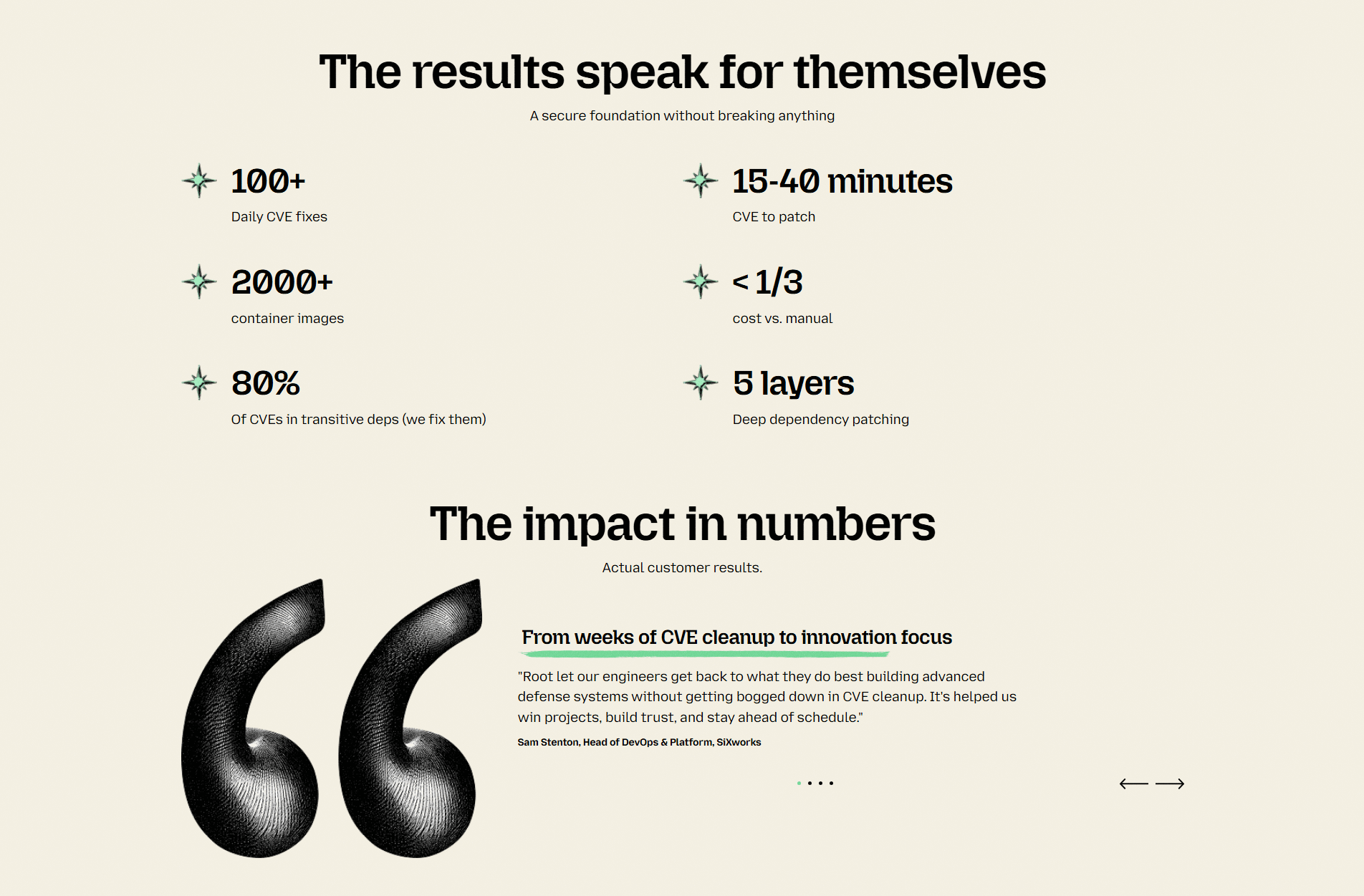
1The hard numbers anchor the value: 100+ daily CVE fixes, 2000+ container images, and 80% of transitive-dep CVEs
2Speed metrics make the payoff concrete: 15-40 minutes CVE-to-patch and under 1/3 the manual cost
3The named testimonial (Sam Stenton, Head of DevOps and Platform at SQworks) puts a real person behind the claim
4Pairing the metric grid with a customer quote (weeks of CVE cleanup to innovation focus) gives proof diversity
Reviewed design-pattern pick from SlimAI’s trust section.
What I love about this section
The hard numbers anchor the value: 100+ daily CVE fixes, 2000+ container images, and 80% of transitive-dep CVEs
Speed metrics make the payoff concrete: 15-40 minutes CVE-to-patch and under 1/3 the manual cost
The named testimonial (Sam Stenton, Head of DevOps and Platform at SQworks) puts a real person behind the claim
Pairing the metric grid with a customer quote (weeks of CVE cleanup to innovation focus) gives proof diversity
Overlooked sections that quietly drive clarity and trust
In this set, navigation and "utility" sections often do more conversion work than teams expect: they shape product understanding, reduce evaluation friction, and route different buyer types before they reach the hero.
The biggest gaps usually appear where the page should explain the technical mechanism and competitive differentiation in plain language. When those sections are thin, the hero gets forced to do all the trust work, and visitors are left guessing about fit. With Testimonial averaging just 45.8, many cybersecurity pages underinvest in the sections that help buyers confirm they are in the right place.
1The open Solutions menu frames choices by job (Augment your SIEM, Adopt a data lake) for intent-based routing
2Tool tiles (Splunk, Microsoft Sentinel, Snowflake, Databricks) let visitors self-select by stack
3A By Team column targets Detection Engineers, IR Analysts, and Security Leadership and CISOs
4The Book a Demo button stays prominent as the primary conversion action
5Log In plus a broad top nav (Product, Learn, Customers, Love) cover returning users and proof
Reviewed overlooked-section pick from Anvilogic’s navbar section.
What I love about this section
The open Solutions menu frames choices by job (Augment your SIEM, Adopt a data lake) for intent-based routing
Tool tiles (Splunk, Microsoft Sentinel, Snowflake, Databricks) let visitors self-select by stack
A By Team column targets Detection Engineers, IR Analysts, and Security Leadership and CISOs
The Book a Demo button stays prominent as the primary conversion action
Use the examples above as prompts for what to standardize, not just what to redesign.
Checklist: a practical audit for cybersecurity website design
If you are iterating on a cybersecurity homepage design, this checklist helps you spot missing sections and messaging gaps quickly, especially around Value Proposition, Cta, and Trust.
Run it on your current page, then decide what to rewrite, what to reorder, and what proof to add before you touch visual polish. For a faster baseline, you can also try our landing page analysis.
Built from 69 sections across 10 cybersecurity homepages in this benchmark. Each check below is a move the highest-scoring pages share, each paired with a real example from the benchmark.
Hero
Can a skeptical buyer tell what you do in five seconds?
The hero makes it instantly clear what the product is and who it's for.
Example: Enhanced.io's hero leads with "Most MSPs lose enterprise deals," naming the exact fear its MSP buyers carry.
The hero names a specific buyer instead of speaking to everyone.
Example: Faraday calls out "data science and engineering teams" in the hero so technical buyers know the tool is for them.
Proof is visible before the first scroll.
Example: Waratek surfaces trust logos (AWS Partner Network, Red Hat, Azure) in the first screen instead of holding proof for a later section.
Trust
Does the page earn belief before it asks for anything?
The proof is quantified with hard numbers.
Example: Wiz leads with third-party scores, G2 at 4.7 out of 5 across 772+ reviews and Gartner Peer Insights at 4.8 out of 5.
Recognizable customer logos carry the authority.
Example: Anvilogic names SAP, Rakuten, SurveyMonkey, and Alteryx as adopters instead of showing anonymous badges.
The proof mixes more than one kind of evidence.
Example: Semgrep combines a 96% security-research agree rate, 45+ enterprise customers, logos like Vanta, and a named Alan Reyes testimonial, so no single claim carries the section.
Features
Do features connect to outcomes the buyer cares about?
Feature copy leads with the outcome.
Example: Veridas opens each card with what the buyer gets, "Authenticate customers instantly," before naming the capability.
A link sends curious buyers deeper without leaving the flow.
Example: Wiz drops a "Learn more" link under each tab so evaluators can go deep without losing their place.
Call to action
Does the next click feel safe to a cautious buyer?
One primary action dominates, with action-led copy.
Example: Anvilogic lets one verb-led "Augment your SIEM" button own the block with no competing link.
A lighter secondary path sits beside the main button.
Example: SlimAI pairs its "Pull vulnerability free now" button with a lower-commitment "Book a demo" path for visitors who want guidance first.
A product visual or asset sits next to the ask.
Example: Wiz sets its real security-graph UI beside the "Get a demo" button instead of leaving the block bare.
The gap most cybersecurity pages leave open is pricing.
Pricing is by far the rarest section in the cybersecurity set. Of 10 companies benchmarked, only one exposes a pricing block clear enough to score. Waratek is the exception, lining up two remediation tiers side by side, "Open Source Apps" versus "Closed-Source Apps," each labeled by who it fits. Pages that route every buyer to "contact sales" leave the cheapest trust on the table.
Interactive quiz
What would your cybersecurity homepage score?
Question 1 of 5
0%
Can a security buyer understand what threat you address in under 5 seconds?
"Runtime application protection for Java" beats "next-generation security platform."
Reviewed by
Gabriel Amzallag , Founder, Web Anatomy
5 years CRO + SEO at Qonto (2021–2025). After advising 15+ SaaS on their websites (Payfit, Pigment…), the same patterns kept breaking, so I decided to build the source of truth on what works on the web: the intelligence layer every tool, builder, and team uses to ship sites that perform.
See how your page compares to the 51.7 average page score
Run a diagnostic on your cybersecurity page and get a section-by-section breakdown of what to fix first to improve clarity, proof, and product evidence.
Quick answers based on our cybersecurity website benchmark dataset.
What are the best cybersecurity websites?
[01]
The strongest performers in this June 2026 benchmark are Veridas, Anvilogic, Stytch, SlimAI, and Waratek. Across 18 cybersecurity homepages scored against 60+ criteria, these pages convert by pairing quantified outcomes with real product evidence: Anvilogic's 45% alert noise reduction, Stytch's 7-row Auth0 comparison matrix, and Waratek's 100% false-positive accuracy claim anchored to a runtime architecture diagram.
What makes cybersecurity websites harder to convert than generic SaaS pages?
[02]
Security buyers evaluate with higher technical scrutiny and refuse to commit until they see the mechanism. Across 18 homepages reviewed, the pages that convert replace fear-based messaging with verifiable proof: Anvilogic quantifies SIEM improvement with 98% confidence and 50%+ MTTD reduction, Veridas segments Industries and Use Cases in the mega menu so visitors self-qualify, and SlimAI names a 15-40 minute remediation window with a "Production-Ready Patch" deliverable.
What is the biggest design mistake on cybersecurity homepages?
[03]
Leading with vague threat language like "protect your organization" while hiding the mechanism. The average page in this June 2026 benchmark scored 51.7. Top performers show the how: Waratek diagrams Java Runtime vs WAF with a patented tainting engine, Anvilogic ships real product dashboards instead of stock illustrations, and Stytch owns the comparison frame against Auth0 before visitors build their own shortlist.
What sections should a cybersecurity homepage include?
[04]
A hero with a quantified outcome, early product evidence (dashboard, architecture diagram, or detection flow), a how-it-works section anchored to a timeline and named deliverable, role-based segmentation for CISO versus engineer, and dual CTAs for technical and economic buyers. Anvilogic and SlimAI stack these well. Across 18 homepages, pages that bury the mechanism convert least.
How many cybersecurity examples do I need to review before redesigning?
[05]
Three to five is enough if you pick by security category. Only 3% of pages in this benchmark score in the top tier, so the gap is concentrated in a few blocks. Study Veridas for vertical-plus-use-case navigation, Anvilogic for quantified SIEM outcomes, Stytch for comparison-first positioning, SlimAI for workflow specificity, and Waratek for defensible technical moat.
Where can I find great cybersecurity website design inspiration?
Use a structured rubric that checks clarity, proof, and friction instead of relying on subjective feedback. Run your page through the landing page analyzer for a section-by-section score against the same 60+ criteria used in this benchmark.