Skip to content

Biotech website design examples, ranked by benchmark

We scored 3 biotech homepages on 60+ conversion criteria. See which sections separate the top performers, and what your page is probably missing.

Updated June 20263 pages analyzed
#CompanyScore

Scored by AI across 60+ conversion criteria

Benchling landing page
#1
43/100
Scroll to explore
Analyze your pageFree. Takes 2 minutes.

What high-performing biotech homepage design gets right

Biotech pages have to earn scientific credibility and explain complex products to buyers who range from researchers to investors. The strongest pages in this benchmark do four jobs early:

43.9/100

Avg. page score

  • Lead with scientific credibility in the first viewport. Show published data, pipeline stages, or peer-reviewed results so the visitor trusts the science before evaluating the business.
  • Make the product story concrete. Translate complex biology into a clear problem-solution narrative that a non-specialist stakeholder can follow in under ten seconds.
  • Surface regulatory and compliance proof early. FDA status, GMP certifications, or partner logos build the institutional trust that biotech buyers require before engaging further.
  • Give different audiences a clear path. Researchers, investors, and commercial partners evaluate biotech pages with different priorities, so the strongest pages route each audience to relevant proof fast.

Biotech website design examples

A benchmark-backed look at biotech website design, focused on what today’s best biotech websites do to communicate credibility, clarity, and conversion intent across the full page experience.

01

Benchling, Product-led lab software with platform credibility

Editor's pick43/100
Gabriel AmzallagGabriel AmzallagFounder, Web Anatomy

Clean, corporate, and UI-forward, Benchling balances platform positioning with concrete proof and workflow specificity. The experience feels enterprise-ready, with clear messaging, credible validation, and detailed segmentation that stays coherent.

What makes this page stand out

  • Three core value pillars — digitize your lab, automate workflows, increase productivity with AI — address the complete lab modernization journey
  • "Loved by 200,000 scientists" and "more than half of the world's top 50 biopharma companies" provide dual social proof across individual adoption and enterprise validation
  • Concrete ROI metrics (63% reduction in data capture time, 10x throughput increase, 4 hours/week saved per scientist) quantify tangible productivity gains
  • Solutions segmented by workflow (Bioresearch, Bioprocess, In Vivo, Connect) and modality (gene therapy, cell therapy, antibodies, RNA therapeutics) demonstrate deep scientific specialization

Section we love

·Trust
Benchling Trust section
  1. 1The headline claims 200,000 scientists plus half of the world top 50 biopharma companies
  2. 2Recognizable customer logos (Gilead, AC Immune) anchor brand authority
  3. 3Hard outcome stats (63% reduction in time on data capture, 10x throughput) quantify value
  4. 4Combines logos, headline counts and outcome metrics for layered proof diversity
  5. 5Real photos of scientists at the bench reinforce a credible research audience
02

Recursion, Platform narrative for AI-driven drug discovery

35/100
Gabriel AmzallagGabriel AmzallagFounder, Web Anatomy

Bold and modern with a tech-forward, editorial feel, Recursion tells a cohesive platform story backed by credible partnerships and real pipeline signals. The page stays structured, helping visitors grasp complex work quickly.

What makes this page stand out

  • Massive proprietary dataset (biological, chemical, clinical) creates a defensible data advantage
  • Partnership model with major pharma companies (Roche, Bayer) validates the technology
  • Automated robotic lab capabilities differentiate from purely computational approaches
  • OS (Operating System) for drug discovery positioning creates a platform narrative

Section we love

·Cta
Recursion Cta section
  1. 1One dominant CTA (Explore our pipeline) keeps the block focused on a single next step
  2. 2Action verb (Explore) tells the visitor exactly what they will do next
  3. 3Real pipeline chart with named indications and trial phases shows concrete proof beside the CTA

Compare your biotech page score to the 43.9 average

Run your page through the same section-level rubric used in this benchmark to find what to fix first, and which patterns to keep.

Biotech design trends we keep seeing

In biotech website design, the strongest pages reduce ambiguity quickly by stating what the product is, who it’s for, and what outcome it drives in plain language.

High-performing biotech homepage design shows concrete product evidence early (especially in the hero); for reference, see our best hero section examples. Use-case segmentation also tends to outperform generic feature lists when audiences span multiple modalities and workflows.

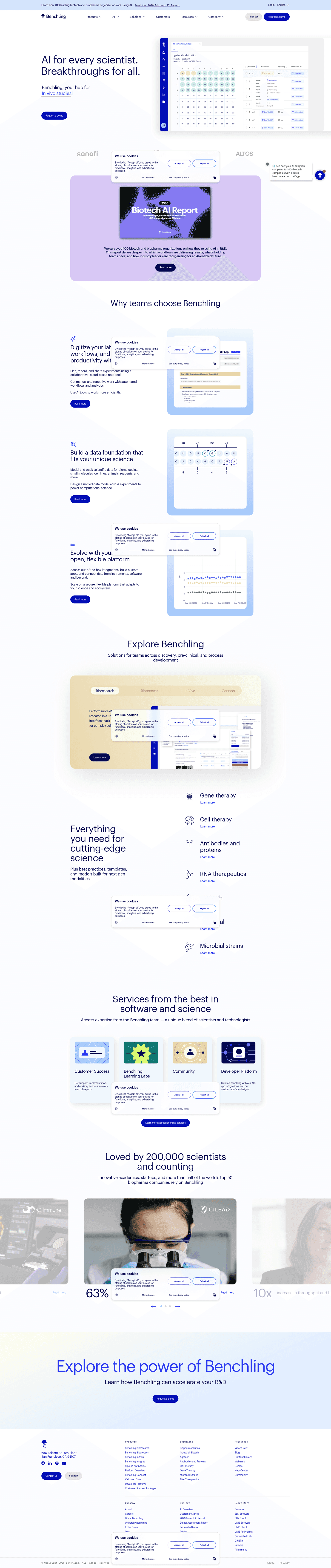
Value Proposition Benchling

67/100

How Benchling presents their value

Benchling value proposition section
  1. 1Three distinct pillars (AI automation, unified data model, open platform) each with icon, copy, and product UI
  2. 2Every prop shows a real Benchling screenshot (AI notebook checks, molecule modeling, titer results chart) proving the claim
  3. 3Read more link under each pillar gives prospects a path to technical depth without cluttering the section
  4. 4Concrete capabilities named: model biomolecules, cell lines and reagents; out-of-the-box and custom integrations

Reviewed design-pattern pick from Benchling’s value proposition section.

What I love about this section

  • Three distinct pillars (AI automation, unified data model, open platform) each with icon, copy, and product UI
  • Every prop shows a real Benchling screenshot (AI notebook checks, molecule modeling, titer results chart) proving the claim
  • Read more link under each pillar gives prospects a path to technical depth without cluttering the section
  • Concrete capabilities named: model biomolecules, cell lines and reagents; out-of-the-box and custom integrations

Features Benchling

67/100

How Benchling showcases their product

Benchling features section
  1. 1Benefit-led copy (Perform more efficient research in an interface purpose-built for complex science) over feature names
  2. 2Tabs organize features by workflow (Bioresearch, Bioprocess, In Vivo, Connect) so teams jump straight to their use case
  3. 3Learn more button routes prospects to a dedicated page for the selected solution area
  4. 4Real product screenshot of the Plasmid Prep Generation and QC interface shows the actual tool, not an abstraction

Reviewed design-pattern pick from Benchling’s features section.

What I love about this section

  • Benefit-led copy (Perform more efficient research in an interface purpose-built for complex science) over feature names
  • Tabs organize features by workflow (Bioresearch, Bioprocess, In Vivo, Connect) so teams jump straight to their use case
  • Learn more button routes prospects to a dedicated page for the selected solution area
  • Real product screenshot of the Plasmid Prep Generation and QC interface shows the actual tool, not an abstraction

Cta Recursion

60/100

How Recursion drives action without pressure

Recursion cta section
  1. 1One primary CTA (Partner with Recursion) keeps the partnership ask front and center
  2. 2Action verb in the button (Partner with Recursion) states exactly what the visitor commits to
  3. 3Play-button video (Pharma's Most Powerful Supercomputer) gives undecided visitors a lower-commitment way to engage

Reviewed design-pattern pick from Recursion’s cta section.

What I love about this section

  • One primary CTA (Partner with Recursion) keeps the partnership ask front and center
  • Action verb in the button (Partner with Recursion) states exactly what the visitor commits to
  • Play-button video (Pharma's Most Powerful Supercomputer) gives undecided visitors a lower-commitment way to engage

Sections biotech teams underuse (but should not)

A clear “how it works” flow often separates casual interest from real intent, especially when the science is complex and trust needs to build step by step.

Resource hubs and footers are easy to treat as housekeeping, but they often carry the diligence load: answering questions, guiding exploration, and reinforcing credibility without disrupting the main path.

Resources Benchling

60/100

How Benchling educates before they sell

Benchling resources section
  1. 1Original research front and center: 2026 Biotech AI Report built from a survey of 100 biotech and biopharma orgs
  2. 2Report topic (how teams use AI in R&D) maps directly to Benchling's core lab and research audience
  3. 3Single Read more CTA drives the visitor into the full report and deeper site content

Reviewed overlooked-section pick from Benchling’s resources section.

What I love about this section

  • Original research front and center: 2026 Biotech AI Report built from a survey of 100 biotech and biopharma orgs
  • Report topic (how teams use AI in R&D) maps directly to Benchling's core lab and research audience
  • Single Read more CTA drives the visitor into the full report and deeper site content

Footer Benchling

60/100

How Benchling closes the page with confidence

Benchling footer section
  1. 1Four labeled columns (Product, Resources, Contact, Legal) group links by intent for quick scanning
  2. 2AICPA SOC and HIPAA Compliant badges sit in the footer to reinforce security for healthcare buyers
  3. 3Legal column lists Terms, SOC 2 Type II, Privacy and Security for clear policy and compliance access
  4. 4Contact column points to Contact Sales and Get Support so late-stage visitors find a path to talk

Reviewed overlooked-section pick from Benchling’s footer section.

What I love about this section

  • Four labeled columns (Product, Resources, Contact, Legal) group links by intent for quick scanning
  • AICPA SOC and HIPAA Compliant badges sit in the footer to reinforce security for healthcare buyers
  • Legal column lists Terms, SOC 2 Type II, Privacy and Security for clear policy and compliance access
  • Contact column points to Contact Sales and Get Support so late-stage visitors find a path to talk

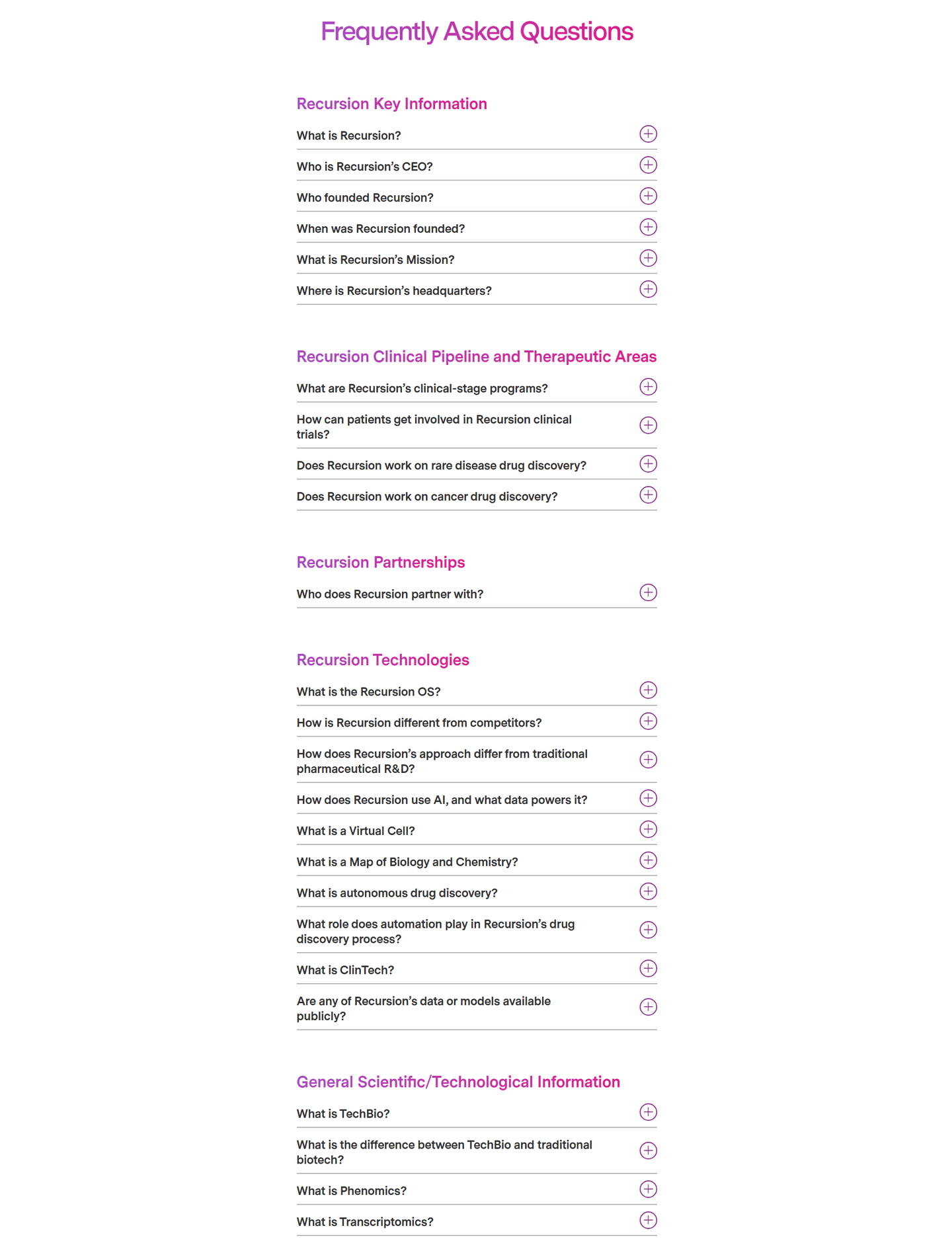
Faq Recursion

50/100

How Recursion handles objections through FAQ

Recursion faq section
  1. 1Five labeled topic headers (Key Information, Clinical Pipeline, Partnerships, Technologies, General Scientific) let each audience jump to its concern
  2. 2Accordion with plus icons keeps 20-plus questions scannable despite the heavy volume
  3. 3Structured question-and-answer pairs follow the format search engines can index for rich results
  4. 4Coverage spans company basics to deep science (What is a Virtual Cell, How does Recursion use AI) to serve investors and researchers alike

Reviewed overlooked-section pick from Recursion’s faq section.

What I love about this section

  • Five labeled topic headers (Key Information, Clinical Pipeline, Partnerships, Technologies, General Scientific) let each audience jump to its concern
  • Accordion with plus icons keeps 20-plus questions scannable despite the heavy volume
  • Structured question-and-answer pairs follow the format search engines can index for rich results
  • Coverage spans company basics to deep science (What is a Virtual Cell, How does Recursion use AI) to serve investors and researchers alike

If you’re refreshing your page, treat the section types below as quick-win candidates before rewriting core messaging.

Checklist to apply these patterns to your page

Use the checklist to audit your page against the same section framework used in this review, then turn gaps into a short, testable set of edits.

For a faster baseline, try our landing page analyzer to benchmark your sections and see what to fix first.

Interactive quiz

How strong is your biotech homepage?

Question 1 of 5
0%

Can a biotech buyer identify what you do in under five seconds?

The headline should name the job, buyer, or workflow directly.

Gabriel Amzallag

Reviewed by

Gabriel Amzallag , Founder, Web Anatomy

5 years CRO + SEO at Qonto (2021–2025). After advising 15+ SaaS on their websites (Payfit, Pigment…), the same patterns kept breaking, so I decided to build the source of truth on what works on the web: the intelligence layer every tool, builder, and team uses to ship sites that perform.

Compare your biotech page score to the 43.9 average

Run your page through the same section-level rubric used in this benchmark to find what to fix first, and which patterns to keep.

Analyze your biotech pageFree. Takes 2 minutes.
Benchmark-backed biotech website design FAQs

Biotech website design: FAQ

Answers based on a benchmark review of {count} biotech websites.

What are the best Biotech websites?

[01]

The strongest performers in this June 2026 benchmark are Benchling and Recursion, alongside other top pages from the 3-page leaderboard. Rankings come from a section-by-section scoring audit against 60+ conversion criteria, hero, value proposition, trust, features, CTA, rolled up into an overall score, not a subjective favorites list.

What makes Biotech websites harder to convert than generic SaaS pages?

[02]

Biotech buyers need scientific credibility and risk reduction before they'll take a "book a demo" step. Across 3 homepages reviewed, the pages that convert anchor the viewport with verifiable proof: Benchling opens with three concrete product pillars (digitize your lab, automate workflows, accelerate discovery with AI); Recursion leads with its proprietary biological, chemical, and clinical dataset as a defensible data advantage. Abstract language loses; specific assets win.

What is the biggest design mistake on Biotech homepages?

[03]

Vague "accelerate discovery" headlines instead of a specific outcome tied to a named buyer and a visible proof asset. The average page scored 43.9 across 3 homepages reviewed. Top performers replace abstraction with concrete evidence, Benchling's workflow-specific value pillars, Recursion's named partnerships and pipeline signals, so a skeptical researcher or investor has something verifiable to anchor on in the first viewport.

What sections should a Biotech homepage include?

[04]

A strong biotech homepage includes a clear hero (audience plus outcome), a proof layer (logos, publications, partnerships, or pipeline stages), a simple "how it works" explanation, key use cases with visuals, and a clear next step (demo, contact, or talk to an expert). Benchling's three value pillars and Recursion's partnership-led platform story are concrete templates. Each section earns the next scroll with a specific, verifiable claim.

How many Biotech examples do I need to review before redesigning?

[05]

Three to five strong examples are usually enough. With 3 biotech pages benchmarked and only 0% reaching top-scoring, section-level comparison (hero vs hero, proof vs proof) matters more than collecting full-page references. Study Benchling for platform clarity and Recursion for data-asset positioning, then audit yours against the same rubric.

Where can I find great inspiration for my Biotech website?

[06]

Study pages section by section, not as full-page moodboards. Browse best landing page examples for the full gallery, then drill into hero section examples, trust section examples, and pricing section examples to see how Benchling and Recursion differ at each funnel stage.

How do I audit my Biotech homepage?

[07]

Use a structured rubric that checks clarity, trust, and friction instead of relying on subjective feedback. Run your page through the landing page audit for a section-by-section score.