Skip to content

Best Marketing Website Examples (And Why They Convert)

We scored 95 marketing homepages on 60+ conversion criteria. See which sections separate the top performers, and what your page is probably missing.

Updated June 202695 pages analyzed
#CompanyScore

Scored by AI across 60+ conversion criteria

Perspective landing page
#1
75/100
Scroll to explore
Analyze your marketing pageFree. Takes 2 minutes.

What the best marketing websites get right

Marketing buyers arrive already skeptical of marketing. They know the playbook. The strongest marketing website design patterns in this benchmark do four things consistently:

51.2/100

Avg. page score

  • Lead with a specific outcome, not a category label. Pair a concrete benefit with quantified proof so the visitor knows what changes if they sign up.
  • Show the product working, not just described. Pages that include real UI, workflow diagrams, or dashboards outperform those that rely on stock imagery or abstract promises.
  • Use visual hierarchy to move the eye from promise to proof to action without friction. The strongest pages organize information so nothing competes with the primary message.
  • Back claims with third-party proof early. Review badges and external validation establish credibility before the visitor is asked to commit, reducing the "trust tax" marketing tools face in a crowded market.

6 best marketing homepages analyzed in detail

Each company below is paired with its strongest section and scored across 60+ conversion criteria. See what they get right, and what you can borrow.

01

Perspective, Marketing platform with layered educational resources and human proof.

Editor's pick75/100
Gabriel AmzallagGabriel AmzallagFounder, Web Anatomy

Perspective builds trust through resource depth: community access, a crash course, and an academy create three entry points for different buyer readiness levels. A named team member humanizes the brand, and the wider bottom card uses visual weight to steer attention toward the highest-value action. The resources section scored 60, showing that breadth of educational content can differentiate a marketing platform even when the core product is not shown.

What makes this page stand out

  • "Easily create mobile-first, interactive, and personalized lead gen and sales funnels with market-leading conversion rates in just 30 minutes" packs multiple differentiators into one sentence: mobile-first, interactive, personalized, fast time-to-value.
  • "No design or coding skills required" removes the primary adoption barrier for the target audience (SMBs and agencies).
  • "Create free funnel in 30 min" CTA is brilliantly specific — the time commitment sets concrete expectations and makes the action feel achievable.
  • Dual review scores (G2 4.9, OMG 4.8) provide exceptionally high ratings that build immediate trust, complemented by "1k+ growth community" showing ecosystem engagement.

Section we love

·Resources
Perspective Resources section
  1. 1Heading Not sure where to start meets beginner anxiety and routes new users to the right resource
  2. 2All three resources (Community, Funnel Crash Course, Marketing Academy) center on funnel marketing, Perspective's core use case
  3. 3Original formats like a 60-minute live crash course and an Academy led by Head of Content Leni build real authority
  4. 4Each card carries a Learn more CTA that links into the deeper resource
02

Comet Rocks, Conversational marketing with a nav that does the selling.

74/100
Gabriel AmzallagGabriel AmzallagFounder, Web Anatomy

Comet Rocks earns a top-scoring navbar with product feature tabs covering Micro-storefronts, Conversational UI, and Dynamic FAQs. Dual CTAs (Start Free and Book Demo) let visitors self-select by intent, and pricing visibility in the dropdown removes a common friction point. The navigation does the positioning work that most marketing pages leave to the hero alone.

What makes this page stand out

  • "Micro-storefronts" concept creates a new product category — not landing pages, not full stores, but personalized shopping funnels
  • Price anchoring ($49/mo starting) in the hero removes a major objection early and signals accessibility
  • Brand logos (NARS, Supercilium, Qure) provide social proof from recognizable beauty/lifestyle brands
  • "From ad click to checkout" clearly maps the user journey, making the value proposition immediately tangible

Section we love

·Footer
Comet Rocks Footer section
  1. 1Links grouped into 4 labeled columns (Legal, Company, Resources, Connect) for easy scanning
  2. 2Newsletter signup with email field and Subscribe button captures non-buyers as secondary conversion
  3. 3GDPR compliance badge displayed near the bottom reinforces trust
  4. 4Imprint and Privacy policy links give clear legal transparency
03

Mailwarm

74/100

What makes this page stand out

  • The hero headline “Email warmup tool to avoid the spam folder” pairs with the blunt subline “Don’t land in spam anymore.”
  • The hero uses two CTAs—“Start Email Warmup” and “Talk to an Email Expert”—covering self-serve and assisted paths.
  • The “Mailwarm Warming Process” section visualizes results with large percentages like “Opens 75%” and “Reputation 88%.”
  • The trust layer stacks a Y Combinator logo, a Product Hunt top-post badge, and “Trusted by 10,000+ teams” plus brand logos.

Section we love

·How It Works
Mailwarm How It Works section
  1. 1Three numbered steps (Sign Up Now, Link your email account, Start the email warmer) each carry a one-line description
  2. 2Low-effort framing (Ready in Minutes, Easy 2-min setup, Get started in seconds) shrinks perceived friction before signup
  3. 3Concrete 2-min timeline sets a clear expectation for how fast warmup goes live
  4. 4Inline Create Account form with a Continue button lets visitors start the moment the process feels easy, with a hand-drawn arrow guiding the eye to it
04

Rampmetrics, Marketing attribution with cost-objection handling built into the pitch.

74/100
Gabriel AmzallagGabriel AmzallagFounder, Web Anatomy

Rampmetrics scores 67 on its value proposition by drawing a clear line between Consulting and Embedded Services. The copy addresses the cost objection head-on with "without the overhead of an in-house ops team," and accordion UI lets evaluators drill into service details without leaving the page. This is a strong model for marketing agencies and platforms with tiered offerings.

What makes this page stand out

  • The detailed breakdown of homegrown attribution weaknesses (data gaps, cross-channel blind spots, maintenance burden, stale models) validates the buyer's existing frustration with specific evidence
  • Clear differentiation through automated multi-touch attribution eliminates the manual data wrangling that makes homegrown solutions unsustainable as marketing channels multiply
  • The "single source of truth" promise addresses the organizational pain of marketing and sales teams arguing over which channels actually drive revenue
  • Real-time attribution visibility transforms marketing from a monthly reporting exercise into a continuous optimization loop — enabling faster budget reallocation decisions

Section we love

·Navbar
Rampmetrics Navbar section
  1. 1The dark open Solutions menu lays out features in a clean multi-column grid
  2. 2Feature items (Marketing Attribution, Conversion Tracking, Account Based Analytics) carry descriptions
  3. 3Integration callouts for Rampmetrics plus Claude and plus ChatGPT signal an AI-native stack
  4. 4A By Role section routes CMOs, Demand Generation, Analysts, and Marketing Operations
  5. 5Pricing sits top-level and the green Book Demo button with a Login link covers both paths
05

ZoomInfo, B2B data platform with review-count authority in the hero.

74/100
Gabriel AmzallagGabriel AmzallagFounder, Web Anatomy

ZoomInfo leads with a G2 badge citing 8,000+ reviews and a red Free Trial button that creates immediate visual contrast. The "B2B data and software" positioning is blunt and effective: it tells the buyer exactly what category they are in. The hero scored 56, lifted by the combination of social proof density and a single, clear action.

What makes this page stand out

  • The "#1 GTM Platform" claim in the page title is bold category ownership — supported by G2 Grid leadership and Forrester Wave recognition
  • Social proof is exceptionally well-quantified: 35,000+ customers, 54% increase in customer engagement (Seismic), 43% more likely qualified pipeline, 4x pipeline growth, 40% increase in closed-won deals
  • The role-based solution navigation (Sales Development, Account Executive, Account Management, RevOps, Demand Generation) shows deep ICP understanding and personalized messaging paths
  • Named customer testimonials with specific titles and companies (Seismic CBO, Spekit RevOps Manager) add credibility through executive-level social proof

Section we love

·Hero
ZoomInfo Hero section
  1. 1G2 badge with 8,000+ reviews and 5 stars provides massive third-party validation
  2. 2Red Free Trial button on dark background creates the highest possible contrast for the CTA
  3. 3B2B data and software subtext clearly positions ZoomInfo as a sales intelligence platform
  4. 4Grow Yours headline combined with connect and close your most valuable buyers promises revenue outcomes
06

Beamly, No-code marketing builder with a top-scoring how-it-works section.

72/100
Gabriel AmzallagGabriel AmzallagFounder, Web Anatomy

Beamly earns a top-scoring how-it-works score with "Four easy steps" framing that turns a potentially complex workflow into a scannable sequence. No-code drag-and-drop messaging reduces effort perception, and an upload UI mockup shows the product in action before the visitor has to commit. This is how marketing tools should explain themselves to non-technical buyers.

What makes this page stand out

  • Key features and capabilities are highlighted upfront: creator discovery, campaign management, content approval workflows, and performance analytics — the full brand-creator collaboration lifecycle
  • The product explanation makes the workflow tangible: brands find creators, brief them, review content, approve deliverables, and measure results — all within one platform
  • Creator economy positioning taps into a massive growth market where brands are shifting budget from traditional advertising to influencer and creator partnerships at an accelerating rate
  • The brand-side focus (helping brands manage creator relationships) rather than creator-side (helping creators monetize) creates a clearer monetization model: brands have bigger budgets than individual creators

Section we love

·Pricing TableBest in class
Beamly Pricing Table section
  1. 1Full feature matrix lays 60+ rows against Creator and Business columns with checks and values for effortless comparison
  2. 2Four labeled categories (Content & Publishing, Monetization & Audience, Website Builder & SEO, More features) keep the long list organized
  3. 3Info (i) icons on every feature row offer hover explanations without cluttering the table
  4. 4Differing values like 1 show versus 10+ shows and 2 seats versus Unlimited seats spotlight the upgrade reasons per row
  5. 5Plan headers repeat at each category and two Try for free buttons sit at the bottom of each column for easy conversion

See how your page compares to the 51.2 marketing average

Run a section-by-section diagnostic on your marketing page and get prioritized fixes, then see how you stack up against these marketing website examples.

Design patterns across high-performing marketing pages

Across 95 marketing pages reviewed, the strongest pages earn attention by proving their value before asking for commitment. Something marketing buyers demand because they already know the tricks.

The clearest marketing website examples treat visual hierarchy as a strategic choice, not a design preference. The best pages structure information so the eye moves from a specific promise to verifiable proof to a single clear action. Design patterns from Determ (84x faster reaction time and 20 hours saved per week) and ActiveCampaign (30-day money-back guarantee alongside a revenue dashboard showing $421k) show how quantified proof and risk reducers work together. Explore best landing page examples to see how other industries handle similar trust friction.

Value Proposition Attribuly

100/100

How Attribuly presents their value

Attribuly value proposition section
  1. 1Four growth levers as separate cards, each headline carrying a number: retarget 2x, attribute 99%, grow email list 10x, richer analytics
  2. 2Every card has a custom data visual (50 to 90% donuts, channel journey graph, bar charts, funnel) that shows the lift, not decoration
  3. 3Mechanism is named, not vague: unifies Shopify, Meta, Google, Klaviyo and pushes server-side data into GA4, Looker Studio, BigQuery
  4. 4A Learn More link sits under every card so high-intent merchants can dig into a single lever

Reviewed design-pattern pick from Attribuly’s value proposition section.

What I love about this section

  • Four growth levers as separate cards, each headline carrying a number: retarget 2x, attribute 99%, grow email list 10x, richer analytics
  • Every card has a custom data visual (50 to 90% donuts, channel journey graph, bar charts, funnel) that shows the lift, not decoration
  • Mechanism is named, not vague: unifies Shopify, Meta, Google, Klaviyo and pushes server-side data into GA4, Looker Studio, BigQuery
  • A Learn More link sits under every card so high-intent merchants can dig into a single lever

Testimonial Lemlist

100/100

How Lemlist lets customers do the selling

Lemlist testimonial section
  1. 1Hard metrics headline each card (6x outbound, 5% to 30% of pipeline, 1.5x open rate) so the proof is verifiable
  2. 2The bold metric callouts (6x, 1,5x) are highlighted as the eye-catch above each story
  3. 3Customer logos (ElevenLabs, Airporting) sit on each card to tie the win to a known brand
  4. 4Before-after framing (from spam to strategy in 90 days) makes the transformation concrete and time-bound
  5. 5Discover full story links open the complete case study and the play icon adds a video testimonial

Reviewed design-pattern pick from Lemlist’s testimonial section.

What I love about this section

  • Hard metrics headline each card (6x outbound, 5% to 30% of pipeline, 1.5x open rate) so the proof is verifiable
  • The bold metric callouts (6x, 1,5x) are highlighted as the eye-catch above each story
  • Customer logos (ElevenLabs, Airporting) sit on each card to tie the win to a known brand
  • Before-after framing (from spam to strategy in 90 days) makes the transformation concrete and time-bound

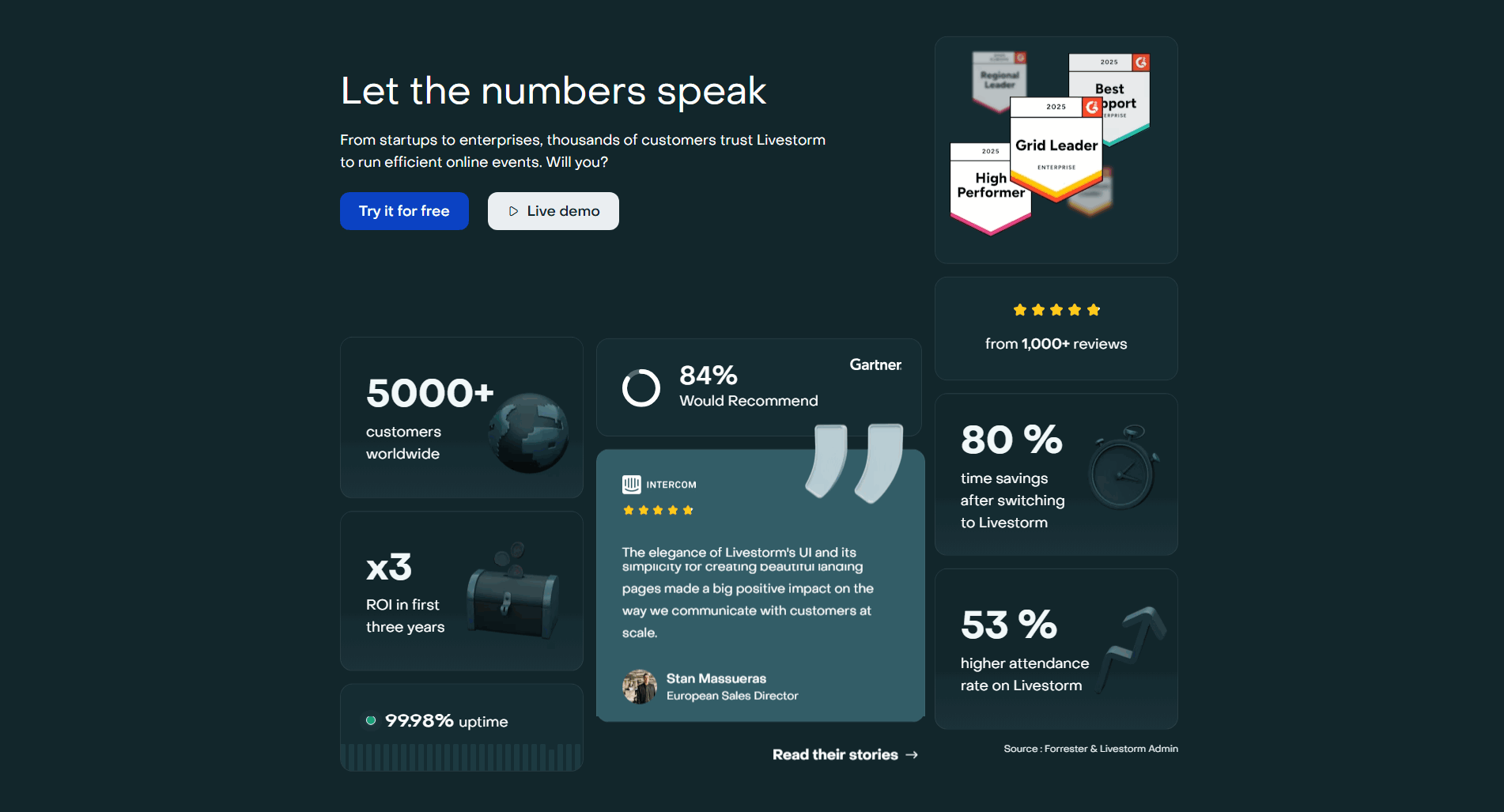
Trust Livestorm

100/100

How Livestorm builds credibility early

Livestorm trust section
  1. 1The metrics are concrete (5000+ customers, x3 ROI in three years, 99.98% uptime, 53% higher attendance).
  2. 2A 5-star rating from 1,000+ reviews plus G2 badges (Grid Leader, High Performer, Best Support) add third-party validation.
  3. 3The Intercom testimonial names Stan Massueras (European Sales Director) with a real photo and 5 stars.
  4. 4The 84% would-recommend stat is sourced to Gartner, lending analyst credibility.
  5. 5Stacking hard numbers, named reviewers, and award badges delivers broad proof diversity.

Reviewed design-pattern pick from Livestorm’s trust section.

What I love about this section

  • The metrics are concrete (5000+ customers, x3 ROI in three years, 99.98% uptime, 53% higher attendance).
  • A 5-star rating from 1,000+ reviews plus G2 badges (Grid Leader, High Performer, Best Support) add third-party validation.
  • The Intercom testimonial names Stan Massueras (European Sales Director) with a real photo and 5 stars.
  • The 84% would-recommend stat is sourced to Gartner, lending analyst credibility.

Overlooked sections that quietly drive signups

Even with a strong hero, secondary sections often decide whether a marketing buyer keeps scrolling, especially when they are comparing multiple tools and need confirmation that yours fits their workflow.

In this dataset, Hero tends to outperform at 54.1 while Testimonial is the most fragile at 40.9, suggesting many marketing pages invest in headline messaging but leave gaps in navigation, use-case routing, and workflow explanation that slow decisions. Concierge AI's action-oriented navbar labels (Engage, Convert, Understand, Amplify) and BlinkMetrics' Day 1/15/30 timeline with done-for-you framing show how underused sections can do heavy conversion work. See how best fintech websites handle similar clarity gaps in adjacent categories.

Pricing Clay

100/100

How Clay creates pricing transparency

Clay pricing section
  1. 1Four named tiers (Free, Launch $167/mo, Growth $446/mo, Enterprise Custom) each with a who-it-is-for one-liner
  2. 2Monthly/Annual toggle showing Save 10% sits right above the cards to nudge yearly billing
  3. 3Recommended badge on the Growth plan anchors attention to the mid-high tier
  4. 4Customer case-study logos (Vanta, Intercom, Google, OpenAI) sit beside the pricing header as social proof
  5. 5Per-action and data-credit breakdown plus Request a quote enterprise CTA cover usage-based and custom buyers

Reviewed overlooked-section pick from Clay’s pricing section.

What I love about this section

  • Four named tiers (Free, Launch $167/mo, Growth $446/mo, Enterprise Custom) each with a who-it-is-for one-liner
  • Monthly/Annual toggle showing Save 10% sits right above the cards to nudge yearly billing
  • Recommended badge on the Growth plan anchors attention to the mid-high tier
  • Customer case-study logos (Vanta, Intercom, Google, OpenAI) sit beside the pricing header as social proof

How It Works Iconosquare

100/100

How Iconosquare simplifies the process

Iconosquare how it works section
  1. 1Three stages (Today, Day 14, Day 28) map a concrete 28-day path from setup to success.
  2. 2Explicit timeframes (Today, Day 14, Day 28) anchor exactly when each milestone lands.
  3. 3Each stage has its own icon and checklist, making the progression easy to scan.
  4. 4The Day 28 column previews the payoff (automate 90% of tasks, save 12+ hours per month).
  5. 5The Road to social media success button gives a clear CTA embedded in the section.

Reviewed overlooked-section pick from Iconosquare’s how it works section.

What I love about this section

  • Three stages (Today, Day 14, Day 28) map a concrete 28-day path from setup to success.
  • Explicit timeframes (Today, Day 14, Day 28) anchor exactly when each milestone lands.
  • Each stage has its own icon and checklist, making the progression easy to scan.
  • The Day 28 column previews the payoff (automate 90% of tasks, save 12+ hours per month).

Use Cases Ahrefs

100/100

How Ahrefs makes the product feel relevant

Ahrefs use cases section
  1. 1Six persona tabs (Agencies, Content Marketers, Ecommerce, Enterprises, ProSEOs, SaaS) let visitors self-select their role instantly
  2. 2Role-matched testimonials from named people (Andrew Oleksik of Suso Digital, Ross Simmonds CEO of Foundation Marketing) build targeted credibility
  3. 3Concrete usage scenarios (integrated across all our SEO SOPs, every team member uses it daily) replace vague claims
  4. 4Hard outcome tied to the Agencies case (21,000+ monthly clicks in business relevant keywords) with a Read Case Study link
  5. 5Third-party rating row (Capterra 4.7, G2 4.5, TrustRadius 9.2, Crozdesk 4.6) reinforces each persona claim

Reviewed overlooked-section pick from Ahrefs’s use cases section.

What I love about this section

  • Six persona tabs (Agencies, Content Marketers, Ecommerce, Enterprises, ProSEOs, SaaS) let visitors self-select their role instantly
  • Role-matched testimonials from named people (Andrew Oleksik of Suso Digital, Ross Simmonds CEO of Foundation Marketing) build targeted credibility
  • Concrete usage scenarios (integrated across all our SEO SOPs, every team member uses it daily) replace vague claims
  • Hard outcome tied to the Agencies case (21,000+ monthly clicks in business relevant keywords) with a Read Case Study link

If you are refreshing a marketing landing page design, treat these "unsexy" blocks as conversion infrastructure, not filler.

Checklist: a practical audit for marketing website design

Built from 336 sections across 74 marketing homepages in this benchmark. Each check below is a move the highest-scoring pages share, each paired with a real example from the benchmark.

Hero

Can a skeptical buyer tell what you do in five seconds?

  • The hero makes it instantly clear what the product is and who it's for.

    Example: Optise calls the buyer out by name, "You are a B2B marketer, not a full-time website expert," so the category and the fit land at once.

  • Social proof is visible before the first scroll.

    Example: Livestorm stacks logos for ramp, Dolby, NHS, and ElevenLabs right under its dual CTAs, so the credibility lands before the visitor scrolls.

  • The hero makes a concrete outcome promise.

    Example: Synthesia leads with "Save up to 90% of time and cost" instead of a generic growth line.

Trust

Does the page earn belief before it asks for anything?

  • Recognizable customer logos carry the authority.

    Example: Blend B2B fronts its trust block with HubSpot badges, "8 HubSpot impact awards" and a "#1 Agency" ranking rather than adjectives.

  • Claims are quantified.

    Example: Mailchimp cites "632% ROI on SMS" and "11 million businesses" while Livestorm cites "5000+ customers" and "99.98% uptime," not vague reassurance.

Value proposition

Is the value concrete, or just adjectives?

  • Benefits are specific.

    Example: Clay pins value to "act on data at scale" and "time outreach perfectly" while Ahrefs names "100+ flexible API endpoints," not a slogan.

  • The outcome is quantified with a number or a result.

    Example: Attribuly headlines each growth lever with a number: "retarget 2x," "attribute 99%," and "grow email list 10x," not generic growth.

Features

Do features connect to outcomes the buyer cares about?

  • Feature copy leads with the benefit.

    Example: Webflow leads with "Make content work harder" and Surfer SEO with "Generate ready to rank article in minutes," naming the result not the tool.

  • The feature shows the outcome.

    Example: Abyssale pairs "Design 100 formats at the speed of 1" with the real product output: a format list and a personalized "Welcome Jason" image.

Call to action

Does the next click feel safe and obvious?

  • One primary action dominates, with action-led copy.

    Example: HubSpot lets "Explore Breeze Agents" dominate with only a lighter "Learn More" link, and ActiveCampaign lets "Get started" own the block.

  • Reassuring microcopy sits next to the button.

    Example: Livestorm pairs its CTA with "No credit card needed, No installation required" and Saleshandy with "No credit card . 7-day free trial."

The thinnest layer on marketing pages is a dedicated trust section.

Of 74 marketing companies benchmarked, only 33 expose a standalone trust section clear enough to score, leaving the hero to carry the credibility alone. The ones that build it stand out fast. Livestorm pairs quantified proof with recognizable logos so a cautious buyer relaxes before reaching the features. Pages that skip the trust layer ask for belief they have not yet earned.

Five quick questions to see where your page stands against this marketing benchmark. For a full section-by-section audit, try our landing page analyzer.

Interactive quiz

What would your marketing homepage score?

Question 1 of 5
0%

Can a marketing buyer identify your core outcome in under 5 seconds?

"Get 3x more demos from your landing pages" beats "the all-in-one marketing platform."

Gabriel Amzallag

Reviewed by

Gabriel Amzallag , Founder, Web Anatomy

5 years CRO + SEO at Qonto (2021–2025). After advising 15+ SaaS on their websites (Payfit, Pigment…), the same patterns kept breaking, so I decided to build the source of truth on what works on the web: the intelligence layer every tool, builder, and team uses to ship sites that perform.

See how your page compares to the 51.2 marketing average

Run a section-by-section diagnostic on your marketing page and get prioritized fixes, then see how you stack up against these marketing website examples.

Analyze your marketing pageFree. Takes 2 minutes.

Explore other industries

See how conversion patterns differ across verticals. Each page scores real homepages on the same framework.

See all industries
Benchmark-backed answers for marketing website design

FAQ: Best Marketing Websites (Marketing Benchmarks)

Quick answers to common questions about what makes the best marketing websites convert, based on section-level benchmark data from this review.

What are the best marketing websites?

[01]

The strongest performers in this June 2026 benchmark are Perspective, Comet Rocks, Rampmetrics, ZoomInfo, Beamly, and Whatagraph. Across 95 marketing homepages scored against 60+ criteria, these pages convert by treating proof as the product: ZoomInfo anchors its hero on a G2 badge citing 8,000+ reviews, Rampmetrics names the cost objection directly ("without the overhead of an in-house ops team"), and Beamly turns the workflow into "Four easy steps" before asking for a signup.

What makes marketing websites harder to convert than other categories?

[02]

Marketing buyers already know the persuasion playbook, so generic promises feel hollow faster. Across 95 homepages reviewed, the pages that convert make proof the headline: ZoomInfo leads with 8,000+ G2 reviews and a red Free Trial button, Whatagraph pairs dual CTAs with a Connect-Organize-Share-Visualize workflow diagram, and Perspective layers three resource formats (community, crash course, academy) with a named team member to humanize the brand.

What is the biggest design mistake on marketing homepages?

[03]

Relying on category labels like "all-in-one marketing platform" instead of specific outcomes. The average page in this June 2026 benchmark scored 51.2. Top performers replace abstraction with proof: Beamly shows an upload UI mockup before asking for commitment, Comet Rocks exposes Micro-storefronts and Dynamic FAQs in the nav so evaluators self-qualify, and Whatagraph cites 1,000+ marketing teams in the first viewport.

What sections should a marketing homepage include?

[04]

A clear hero with one primary action, an early trust layer (review badges, customer counts, integration logos), a visual product overview or workflow, use cases tied to measurable outcomes, and a low-friction CTA with supportive microcopy. Whatagraph's Connect-Organize-Share workflow and Comet Rocks' nav-level product tabs are strong templates. Across 95 homepages, pages that stack these blocks convert most.

How important is visual hierarchy for marketing website design?

[05]

Critical. The strongest pages guide the eye from headline to proof to CTA using contrast, whitespace, and typographic weight. ZoomInfo uses a red Free Trial button against a clean hero to make the action obvious; Rampmetrics uses accordion UI so buyers drill into service tiers without leaving the page. Layout clarity is the single most consistent differentiator between high- and low-performing marketing pages.

Where can I find great marketing website design inspiration?

[06]

Study pages section by section instead of saving full-page screenshots. Browse best landing page examples for the full gallery, then drill into hero section examples, trust section examples, and CTA section examples to see what the strongest marketing pages do differently at each stage of the funnel.

How do I audit my marketing homepage?

[07]

Use a structured rubric that checks clarity, trust, and friction instead of relying on subjective feedback. Run your page through the landing page audit for a section-by-section score.